Learning the Different Coating Stripping Methods

The cladding power stripper also referred to as the multimode optical power stripper is designed for amplifier applications and high power fiber laser. It is an ideal device  for ASE, residual pump power stripping, core modes that have escaped from double cladding fibers inner cladding while ensuring preservation of single power minimal degradation and beam quality (M2). Single power that is reflected into the inner cladding may also be stripped out too.  The handling capability of the stripping power goes to 800W or at times may be even higher

Stripping the Coating

The fibers that most reputable companies supply all come with a standard  acrylate single layer coating or, in some such as the high power products, a coating that is high temperature enduring. In comparison to dual layer coatings, the coatings that are single layer are more brittle and smooth. The coating can be removed readily using the conventional tools for fiber stripping such as the Fitel S-210 Clauss or CFS-1 for 125 μm cladding diameter fiber or for larger cladding diameters the Clauss No Nik stripper is used. For fibers whose outer diameter is non-standard, it is recommended that an adjustable stripper is used.  Thermal strippers such as those that are attached to the Schleuniger FiberStrip 7030 or the Vytran FFS-2000 can be used for all fiber in a safe way.

Alternatively, chemical stripping of fibers can be done using an appropriate solvent. For example, the coating can be exposed for one minute to sulfuric acid at 120°C sulfuric acid. Before the fiber is dipped into the liquid, the tip should be sealed with a drop of glue of 2 mm in diameter or through the end fiber hole collapsing using a fusion splicer.  It is worth noting that most glue types are dissolved in this acid, but epoxies that are two-component such as the Epotek ND353 tends to dissolve in a slower manner than the coating.

It is also possible to obtain chemical stripping through application on the fiber tip, of paint stripper. The paint stripper is usually in the form of a gel so as to reduce the occurrence of out-gassing and can be applied easily using a small brush. After a minute or so, the coating becomes soft and is removed easily using a lens tissue. It is worth noting that paint stripper typically contains dichloromethane (CH2Cl2) and as such there may be restrictions by local regulations to use it. For lower quality and faster stripping, another option would be to use a normal cigarette lighter to burn the coating off. However, the fiber may end up becoming brittle hence not the best choice for stripping.
Fiber Optics Sensors Provide Early Warning for Landslides-DK Photonics

CASERTA, Italy, Sept. 29, 2014 — Fiber optic sensors could warn people of imminent landslides, potentially saving lives and reducing destruction.

A team at the Second University of Naples is developing sensor technology that could detect and monitor both large landslides and slow slope movements. The researchers hope to mitigate the effects of these major natural disasters, similar to the way hurricane tracking can prompt coastal evacuations.

Optical fiber sensors embedded in shallow trenches within slopes would detect small shifts in the soil, the researchers said. Landslides are always preceded by various types of pre-failure strains, they said.

While the magnitude of pre-failure strains depends on the rock or soil involved — ranging from fractured rock debris and pyroclastic flows to fine-grained soils — they are measurable. Electrical sensors have long been used for monitoring landslides, but that type of sensor can be easily damaged, the researchers said. Optical fiber is more robust, economical and sensitive.

“Distributed optical fiber sensors can act as a ‘nervous system’ of slopes by measuring the tensile strain of the soil they’re embedded within,” said professor Dr. Luigi Zeni.

The researchers are also combining several types of optical fiber sensors into a plastic tube that twists and moves under the forces of the pre-failure strains. This will allow them to monitor the movement and bending of the optical fiber remotely to determine if a landslide is imminent.

The use of fiber optic sensors “allows us to overcome some limitations of traditional inclinometers, because fiber-based ones have no moving parts and can withstand larger soil deformations,” Zeni said.

He added that such sensors can be used to cover several square kilometers and monitored continuously to pinpoint critical zones.

The team will present their research at Frontiers in Optics in Tucson, Ariz., next month.


DK Photonicswww.dkphotonics.com  specializes in designing and manufacturing of high quality optical passive components mainly for telecommunication, fiber sensor and fiber laser applications,such as PLC Splitter, WDM, FWDM, CWDM, DWDM, OADM,Optical Circulator, Isolator, PM Circulator, PM Isolator, Fused Coupler, Fused WDM, Collimator, Optical Switch and Polarization Maintaining Components, Pump Combiner, High power isolator, Patch Cord and all kinds of connectors.

Ovum: Optical components market to grow 8% in 2014 from $6.8 bn in 2013

The global optical components (OC) market is expected to grow 8 percent in 2014 from $6.8 billion in 2013, said Ovum.

In 2013, the OC market increased 3 percent from 2012. Ovum said main growth drivers in 2013 were data communication sales driven by large data centers, 100G coherent demand, and unexpected growth in sales of transceivers for fiber-to-the-antenna applications for 4G build-outs.

“Demand for 100G metro–optimized transmission gear will begin shipments and ramp in 2015. Multiple component vendors introduced components and pluggable optics for 100GHz DWDM in anticipation. Opportunities are also emerging in the data center for high-speed interconnects,” said Daryl Inniss, practice leader for Telecoms Components at Ovum.

In the first quarter of 2014, the optical components market declined 1 percent sequentially and grew 7 percent compared to the year-ago period.  New lower telecom prices were one of the main reasons for the marginal growth in OC on quarter-on-quarter basis.

Ovm said demand for 100G components for coherent transmission in WAN, datacom transceivers at 10 and 40G, and fiber-to-the-antenna transceivers is expected to continue. Traffic continues to increase, and high-speed optics being used in new applications are helping to drive the market forward.

Global-optical-components-market-forecast

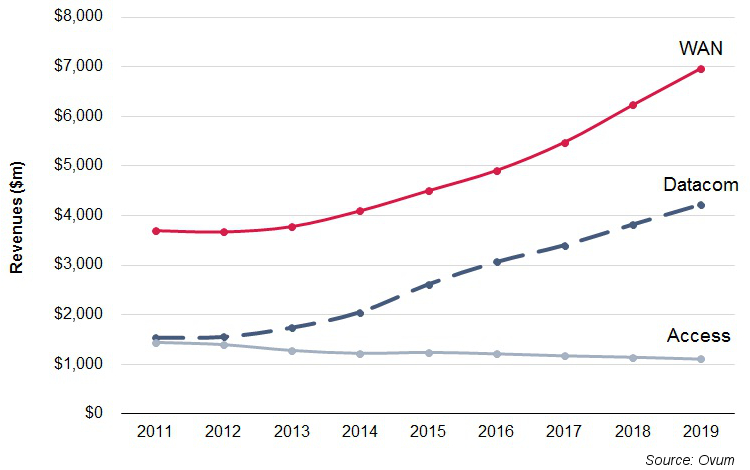
The WAN OC segment, which includes components in telecom carriers’ core and metro networks, the largest segment, will grow at a compound annual growth rate (CAGR) of 11 percent to $7 billion in 2019. Demand for 100G components and modules is a big driver for growth in WAN.  Ovum expects strong demand for pluggable coherent transceivers in 2015.

Datacom will be expanding at a 16 percent CAGR to reach $4.2 billion in 2019 — led by demand for 10 and 40G components in the early years and then 100G in the later years driven by the availability of server ports supporting data rates greater than 10G.

Access — including CATV, FTTx and transceivers for the fiber-to-the-antenna application — will decline at 2 percent CAGR to $1.1 billion in 2019. The decline will be driven by the FTTx application, where volumes are nearly constant through the forecast period but price declines are projected to pull down revenues.


DK Photonicswww.dkphotonics.com  specializes in designing and manufacturing of high quality optical passive components mainly for telecommunication, fiber sensor and fiber laser applications,such as PLC Splitter, WDM, FWDM, CWDM, DWDM, OADM,Optical Circulator, Isolator, PM Circulator, PM Isolator, Fused Coupler, Fused WDM, Collimator, Optical Switch and Polarization Maintaining Components, Pump Combiner, High power isolator, Patch Cord and all kinds of connectors.

Fiber Media Converters in Private Datacom Market Forecast (March 2014)

Fiber Media Converters in Private DatacomMarket Forecast (March 2014)

According to ElectroniCast, the global use of fiber media converters in private datacom networks is expected to reach $1.29 billion in 2014…

Aptos, CA (USA) – March 20, 2014 —ElectroniCast Consultants, a leader in fiber optic market research, announced the release of a new market analysis of the worldwide use of fiber optic / Fiber media converters in private data communications.  A fiber media converter is a networking device that makes it possible to connect two dissimilar media types such as copper with fiber optic cabling, as well as (different) fiber-to-fiber (F2F), such as multimode to single mode optical fiber.

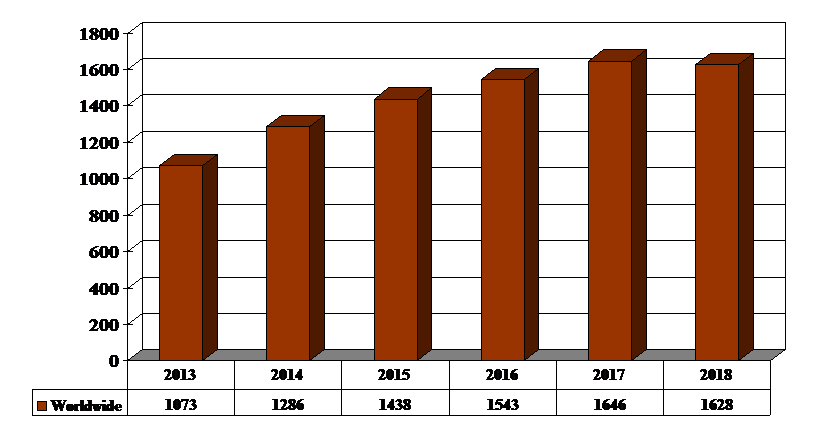
The worldwide value for selected fiber media converters used in private datacom networks reached $1.07 billion in 2013. The consumption value is forecast increase with strongly rising quantity growth partially offset by declining average prices.

The EMEA and the APAC regions are forecast for double-digit consumption value growth during the timeline covered in this study (2013-2018); however, the American region’s growth is forecast to “flatten” and eventually turn to negative.  The worldwide use of private datacom fiber media converters, which are specified in the ElectroniCast market study, is forecast to peak at $1.646 billion in 2017, before slipping to $1.628 billion in 2018.

“The fiber media converters researched in this market study are typically used within an existing Private Enterprise Data Centers (DCs) and Local Area Networks (LANs), as well as other non-public data communication links. They are often used to connect newer 100-Mbps, Gigabit Ethernet, 10G, or other equipment in existing networks, which are generally (copper-based) 10BASE-T, 100BASE-T, or a mixture of both,” stated Stephen Montgomery, Director of the Fiber Optics Components group at ElectroniCast Consultants.

“Several factors make the conversion from copper to optical fiber a good choice, such as – longer link lengths in campuses and industrial plants; resistance to electromagnetic and radio-frequency interference (EMI/RFI) may be necessary; and wider bandwidth capability, just to point-out a few examples,” Montgomery added.

The strong user demand for greater bandwidth and increased interconnectivity to the desktop, throughout the buildings, campuses, from LAN-to-LAN (Metropolitan Area Network – MAN) continues in 2014.

This is matched by rapidly growing demand for global broadband interconnectivity. Interactive multimedia terminals, triple play (voice, video and data), quadruple-play (adding mobility as a communications function to the network), and numerous other dynamics/ applications, continuing bring rapid access to massive databases, which increase productivity while providing rapid ROI (return on investment).

Such expanded capability, however, must often be obtained without making the current network elements obsolete. Local area network (LAN) applications illustrate this trend.  LANs are becoming larger and more complex. Reconfiguration, relocation, and extension of LANs are occurring more frequently, due to organization restructuring, advances in computer usage, and the trend toward decentralized computing.

These changes to LAN cabling represent a major ongoing operational expense and a disruption of work for many companies (enterprises). For example, adding capabilities often requires that network administrators upgrade their existing LANs to another media type: for example, copper-to-fiber, multimode-to-singlemode fiber, or even singlemode –to- different types of singlemode optical fiber (note: copper-to-copper conversion is not covered in the study). By using media converters, the network administrator can achieve these upgrades inexpensively.

According to ElectroniCast, the global use of fiber media converters in private datacom reached $1.07 billion in 2013 and is forecast to peak at $1.646 billion in 2017, before slipping to $1.628 billion in 2018.  


Private Datacom Fiber Media Converter Global Market Forecast,
(Value Basis, $ Million) – Source: ElectroniCast Consultants

Fiber Media Converter
Private Datacom Fiber Media Converter Global Market Forecast,

Note: Market forecast data in this study report refers to consumption (use) for a particular calendar year; therefore, this data is not cumulative data.

DK Photonicswww.dkphotonics.com  specializes in designing and manufacturing of high quality optical passive components mainly for telecommunication, fiber sensor and fiber laser applications,such as PLC Splitter, WDM, FWDM, CWDM, DWDM, OADM,Optical Circulator, Isolator, PM Circulator, PM Isolator, Fused Coupler, Fused WDM, Collimator, Optical Switch and Polarization Maintaining Components, Pump Combiner, High power isolator, Patch Cord and all kinds of connectors.

Where can WDM-PON go next? — DK Photonics

Where can WDM-PON go next?

The current generation of commercial WDM-PON/ 100GHz DWDM systems based on reflective ONU technology is optimized for applications up to 20 km, 40 channels, and 1 Gbps per customer. Current research focuses on how to scale WDM-PON toward higher bit rates and longer reach. Forward error correction is a key technology for scaling the current generation of WDM-PON technology to higher bit rates, longer reach, tighter channel spacing, or a combination thereof. An important challenge is to package the technology in an MSA form-factor pluggable module to maintain its benefits in cost and compatibility with third-party equipment.
A typical requirement for next generation metro/access systems is to enable node consolidation. That means operators can reduce opex by closing down portions of their central offices; at the same time, this goal requires the optical signals to bridge longer distances than what is typical of the access networks of today. Thus, when routing WDM-PON / 1064nm high power isolator signals through the metro part of the network, it becomes necessary to support ring architectures as an alternative to the basic tree structure.
In a ring structure, cascaded filters may decrease the effective channel passband. Since the spectral width of the WDM-PON signal is wider than the signals from a normal DFB source, such filtering effects may affect transmission.
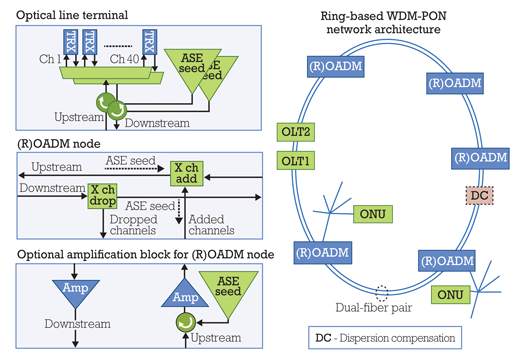
In a recent evaluation project, a partnership between Transmode and Deutsche Telekom Hochschule für Telekommunikation of Leipzig, Germany, achieved 140-km long reach WDM-PON transmission over a ring-based access-network architecture. The partnership investigated the effects of using WDM-PON based on ASE-seeded wavelength-locked transmitters in a ring-based network architecture with cascaded CWDM OADM nodes. Transmission at 1.25 Gbps over 140-km singlemode fiber was demonstrated using an EDFA and dispersion compensation.
The results were first published at ECOC 2013 (In de Betou, Bunge, Åhlfeldt, and Olson, “140km Long-reach WDM-PON Test for Ring-based Access Network Architecture”). This partnership has investigated what opportunities could be provided by WDM-PON technology in such network topologies by studying experimentally the influence of narrow filtering and maximum reach.
The experimental testbed (in Leipzig) was built around Transmode’s TM-Series iWDM-PON system to create an optical line terminal (OLT) (see Figure 2). The OLT has a transponder line card that hosts pluggable wavelength-locked Fabry-Perot transceivers, ASE seed light sources, dual circulators for up- and downstream, and a 40-channel multiplexer based on an AWG.
To reach distances beyond 100 km, amplifiers dispersion compensation, and remote ASE seed sources were used. While an experimental field trial today, it shows that WDM-PON may well continue to evolve to support longer reach and more sophisticated network architectures in the future supporting a broader range of deployment scenarios.
DK Photonics – www.dkphotonics.com specializes in designing and manufacturing of high quality optical passive components mainly for telecommunication, fiber sensor and fiber laser applications,such as High Power Isolator,1064nm Components,PM Components,Pump Combiner,Pump Laser Protector,which using for fiber laser applications.Also have Mini-size CWDM, Optical Circulator, PM Circulator,PM Isolator, Fused Coupler,Mini Size Fused WDM.More information,please contact us.

WDM-PON technology-DK Photonics

WDM-PON provides the dedicated bandwidth of a point-to-point network and the fiber sharing inherent in PONs. The architecture is somewhat similar to that of EPON and GPON; instead of the power-splitter approach used in TDM-PON architectures, WDM-PON uses an arrayed waveguide grating (AWG) filter that separates the wavelengths for individual delivery to the subscriber ONUs (see Figure 1).

A simple, plug-and-play implementation is based on wavelength-locked or tunable lasers. Self-tuning “colorless” ONUs can be used at the subscriber sites to simplify inventory and spare-part handling. Colorless optics not only simplify operations, but also reduce deployment costs, since they don’t need the expensive wavelength-stability components that traditional fixed and tunable optics require. There are multiple approaches to the colorless ONU technology.

In one approach, the wavelength of the ONU transmitter is controlled by injection of a “seed” signal into the transmitter (e.g., a wavelength-locked Fabry-Perot laser or reflective semiconductor optical amplifier). The seed signal injected into the transmitter could come from broadband ASE light sliced through the filters in the system or from a DFB laser array. In a self-seeding version of this approach, the seed light is provided by feedback of broadband light from the transmitter itself. The passive filtering of the seed light in the remote node determines the wavelength of the ONU transmitter.

In a different approach, the colorless ONU contains a singlemode optic coupler wavelength-tunable laser, which is able to tune to the appropriate wavelength that matches the remote node filter port.

Below 10-Gbps channel bit rates, the injection-seeded method provides a cost-efficient approach. As an example, a wavelength-locked Fabry-Perot transmitter can be integrated into an MSA SFP pluggable form-factor module, which enables the use of third-party CPE devices. A modified EDFA gain block in a 70×90 MSA form factor could be used to generate the broadband ASE light that’s used as a seed signal in the system.

At 10-Gbps bit rates, tunable-laser technology offers an alternative to the injection-seeded approach. The tunable-laser technology developed for the metro/long-haul market has matured significantly over the past couple of years and is able to give a good cost-per-bit ratio when high capacity is needed.

If the WDM-PON system is properly designed, then it’s possible to mix different transmission technologies. By following certain design rules during the installation of the WDM-PON system, it’s possible to allow step-wise channel upgrades to higher bit rates when the demand arises. These design rules ensure that channel OSNR requirements will be met in the presence of reflections and that inter-channel crosstalk is avoided. The result is an open and flexible access network that can support many applications and services over the same infrastructure. WDM-PON thus becomes an optical option for the access network as and where it makes sense.

Given its ability to help service providers cope with current bandwidth demands as well as the next potential broadband access bottleneck, WDM-PON100GHz DWDM Module is becoming an important technology to consider in terms of its benefits and market timing. As with any emerging technology, service providers need to consider the optimal strategy for initial deployment of WDM-PON. That includes how they could use WDM-PON for additional network applications as the technology matures and its costs come down.

 WDM-PON technology

WDM-PON technology

FIGURE 2. Architectural scenario explored in the collaboration between Transmode and Deutsche Telekom Hochschule für Telekommunikation.

The latest generations of WDM-PON systems are now gaining traction with operators around the globe for field deployment, lab trials, and evaluations. It’s clearly the early stage of WDM-PON deployments, but progress has started and 2014 looks to be a pivotal year for the technology.

62.5/125 um Vs. 50/125um Multimode fiber Information

We have created this page to illustrate the very basic differences between 62.5 and 50/125 multimode fiber in selecting a patch cable for your existing cable plant.

62.5/125 um Vs. 50/125um Multimode fiber


62.5/125 um Vs. 50/125um Multimode fiber

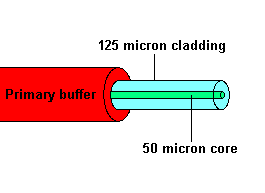
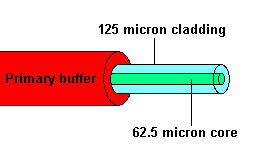
The key thing to remember is to always use a patch cable of the same type as the cable that you are connecting to. It is virtually impossible to tell the difference between the two fiber types (62.5 and 50/125) by looking at the bare fiber* or the connectors*. Usually, this information will be written on the cable’s jacket.

The photos above illustrate that the outer diameters of the two fiber types are the same. What is different is the size of the center light carrying core of the fiber. You cannot see the fiber’s core without a microscope*. Therefore, you must rely on the writing that is on the fibers jacket to determine what type is.

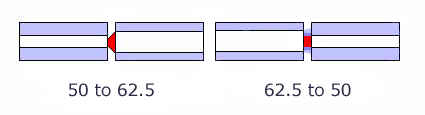
Severe losses of light can occur when you try to match 50/125 and 62.5/125 fiber, as the illustration on the left shows.

62.5/125 um Vs. 50/125um Multimode fiber

* CAUTION: Never look directly into a fiber cable’s end face or into the ferrule of a connector (with fiber present) as there may be dangerous laser light present.

NOTE: This page was designed to help you know the difference between 62.5 and 50/125 fiber for the purpose of purchasing patch cables and products to connect to existing installed cabling. This page was not designed to provide information on choosing between the two types fiber for new installations.

What is Pump Laser Protector, Where is the Pump Laser Protector use?

The Pump Laser Protector (also called Pump Protection Filters) is a passive component which allows maximum transmission from a discrete fibre-coupled pump laser diode and blocks parasitic signals around the centre wavelength of the laser from being reflected back into the laser.

Pump Laser Protector
Multimode Pump Laser Protector -10~30W

Single-emitter laser diodes are highly regarded for their long term reliability. However, these devices are very sensitive to backward propagating light within the delivery fiber. Backward power imaged onto the diode material, as small as 5% of the pump diode output, can cause accelerated diode degradation and, in the majority of cases, catastrophic failure.That is why we need Pump Laser Protector.

DK Photonics offers filter technology that provides protection to pump diodes under these conditions (up to 50 dB Backward Signal Attenuation). Splicing these filters to the pump output fiber rejects unwanted light before it reaches the diode.

Multimode Pump Protection filters are available for a wide range of standard light emitting diodes. Fiber pigtails are 105/125 micron, with both 0.15 and 0.22 NA cores and 50/125 or 62.5/126 MM fiber available. Operating wavelengths cover the majority of diode laser lines (915 nm, 940 nm, 960 nm and 976) and maximum power handling is 25W without water-cooling.DK Photonics recently released a new type of Pump Laser Protector up to 200W handling power with water-cooling technology. And also have SingleMode Pump Laser Protector with Hi1060 fiber for 976nm fiber laser.

If you do not see a Pump Laser Protector from the standard configurations that meets your needs, we welcome the opportunity to review your desired specification and quote a filter best suited to your application. Different pump/rejection wavelengths or fiber pigtail can be accommodated.

DK Photonics – www.dkphotonics.com specializes in designing and manufacturing of high quality optical passive components mainly for telecommunication, fiber sensor and fiber laser applications,such asDK Photonics' promotion products including:High Power Isolator,1064nm Components,PM Components,Pump Combiner,Pump Laser Protector,which using for fiber laser applications.Also have Mini-size CWDM, Optical Circulator, PM Circulator,PM Isolator, Fused Coupler,Mini Size Fused WDM.More information,please contact us.

What is Cladding Power Strippers, Where is the Cladding Power Strippers use?

Cladding Power Strippers: devices which can remove light from a fiber cladding

Cladding Power Stripper

Where is the Cladding Power Strippers use?

In some situations, it is necessary to remove light from the cladding of an optical fiber. Some examples:

-Sometimes, a single-mode fiber is used as a kind of mode cleaner. The wanted light is transmitted through the fiber core, and any other light, spoiling the beam quality, should be removed. In many cases, a polymer coating around the fiber cladding can serve as a Cladding Power Stripper. For that purpose, the refractive index of the coating should be slightly above that of the cladding, so that light can easily be transmitted from the cladding into the coating and then radiated into the ambient air by scattering at irregularities. (Alternatively, the coating may absorb the light.)

-In a high-power fiber amplifier made from a double-clad fiber, residual (unabsorbed) pump light (at the fiber end opposite to the pump end) may have to be removed from the pump cladding (inner cladding) in order to prevent it either from accompanying the amplified signal or from getting to the signal source. A special Cladding Power Stripper may be used for that purpose.

-When pump light is launched into a double-clad fiber (for example, from free space), some of the optical power may get into the outer cladding around the pump cladding. It may propagate in that outer cladding up to a location where the fiber has a polymer coating, and then destroy that coating via excessive heating. That problem may be avoided with a cladding stripper which attenuates light in the outer cladding, but not in the pump cladding.

Cladding Power Stripper for use in high-power fiber lasers and amplifiers need to be able to handle substantial optical powers. It needs to be ensured that these powers are absorbed in a sufficiently widespread region, and that the generated heat can be removed safely, without damaging the mode stripper or any surrounding parts.

Optical Isolators Global Market Forecast

According to ElectroniCast, the Asia Pacific Region leads in the use of optical isolators…

ElectroniCast Consultants, a leading market research & technology forecast consultancy addressing the fiber optics communications industry, today announced the release of a new market forecast of the global consumption of optical isolators in optical communication and specialty applications.

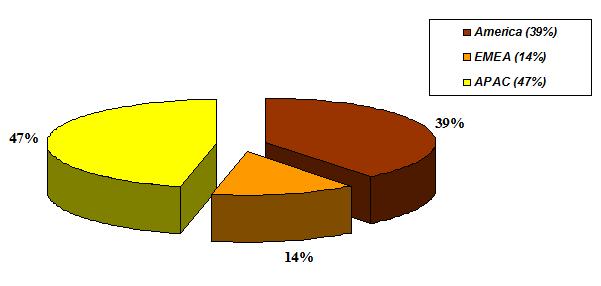
According to ElectroniCast, the Asia Pacific region (APAC), region held the lead in terms of relative market share consumption volume (quantity/number of units) of optical isolators in 2012, with 47 percent; however the Asia Pacific region (APAC), pushed along by the telecommunication category in the People’s Republic of China. The consumption of optical isolators in the APAC region is forecast to nearly triple (3x) during the 2012-2017 time frame.

Optical isolators are passive devices that allow light to be transmitted in only one direction. They are most often used to prevent any light from reflecting back down the optical fiber, as this light would enter the source and cause backscattering and feedback problems. This is especially important for high data rate transceivers and transponders, or those devices requiring long span lengths between transceiver pairs.

Optical isolators are used in many applications in commercial, industrial, and laboratory settings.  They are reliable devices when used in conjunction with fiber optic amplifiers, fiber optic ring lasers, fiber optic links in cable TV/multimedia applications, and high-speed/ DWDM and coherent fiber optic telecommunication communication systems, laboratory R&D, sensors, gyro-systems, test/instrumentation measurement quality assurance applications in automation of manufacturing processes and several others.

ElectroniCast estimates that the Telecommunication applications held 85% of the relative market share of the worldwide consumption volume of optical isolators in 2012.

According to ElectroniCast, 13.4 million optical isolators were used in 2012…

2012 – Optical Isolator Global Volume (Quantity) Market Share (%),

By Region, 13.4 Million Units

optical isolator

DK Photonicswww.dkphotonics.com  specializes in designing and manufacturing of high quality optical passive components mainly for telecommunication, fiber sensor and fiber laser applications,such as PLC Splitter, WDM, FWDM, CWDM, DWDM, OADM,Optical Circulator, Isolator, PM Circulator, PM Isolator, Fused Coupler, Fused WDM, Collimator, Optical Switch and Polarization Maintaining Components, Pump Combiner, High power isolator, Patch Cord and all kinds of connectors.