Testing Fiber Optic Splitters Or Other Passive Devices

A fiber optic splitter is a device that splits the fiber optic light into several parts by a certain ratio. For example, when a beam of fiber optic light transmitted from a 1X4 equal ratio splitter, it will be divided into 4-fiber optic light by equal ratio that is each beam is 1/4 or 25% of the original source one. A Optical Splitter is different from WDM. WDM can divide the different wavelength fiber optic light into different channels. fiber optic splitter divide the light power and send it to different channels.

Most Splitters available in 900µm loose tube and 250µm bare fiber. 1×2 and 2×2 couplers come standard with a protective metal sleeve to cover the split. Higher output counts are built with a box to protect the splitting components.

Testing a coupler or splitter (both names are used for the same device) or other passive fiber optic devices like switches is little different from testing a patchcord or cable plant using the two industry standard tests, OFSTP-14 for double-ended loss (connectors on both ends) or FOTP-171 for single-ended testing.

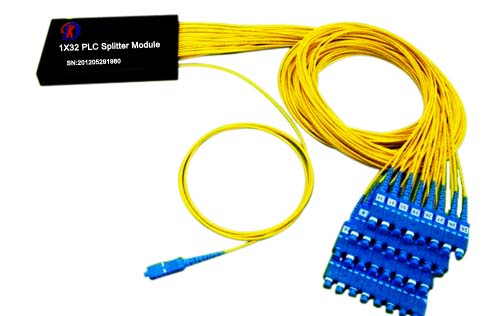
First we should define what these passive devices are. An optical coupler is a passive device that can split or combine signals in optical fibers. They are named by the number of inputs and outputs, so a splitter with one input and 2 outputs is a 1×2 fiber splitter, and a PON splitter with one input and 32 outputs is 1×32 splitter. Some PON splitters have two inputs so it would be a 2X32. Here is a table of typical losses for splitters.

Splitter-Ratio

Important Note! Mode Conditioning can be very important to testing couplers. Some of the ways they are manufactured make them very sensitive to mode conditioning, especially multimode but even singlemode couplers. Singlemode couplers should always be tested with a small loop in the launch cable (tied down so it does not change and set the 0dB reference with the loop.) Multimode couplers should be mode conditioned by a mandrel wrap or similar to ensure consistency.

Let’s start with the simplest type. Shown below is a simple 1X2 splitter with one input and two outputs. Basically, in one direction it splits the signal into 2 parts to couple to two fibers. If the split is equal, each fiber will carry a signal that is 3dB less than the input (3dB being a factor of two) plus some excess loss in the coupler and perhaps the connectors on the splitter module. Going the other direction, signals in either fiber will be combined into the one fiber on the other side. The loss is this direction is a function of how the coupler is made. Some couplers are made by twisting two fibers together and fusing them in high heat, so the coupler is really a 2X2 coupler in which case the loss is the same (3dB plus excess loss) in either direction. Some splitters use optical integrated components, so they can be true splitters and the loss in each direction may different.
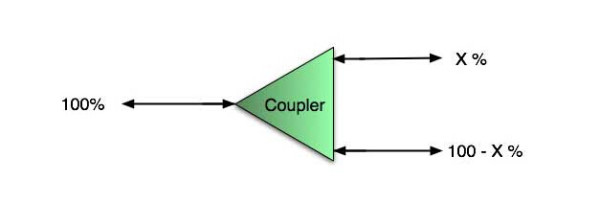
optical coupler

So for this simple 1X2 splitter, how do we test it? Simply follow the same directions for a double-ended loss test. Attach a launch reference cable to the test source of the proper wavelength (some splitters are wavelength dependent), calibrate the output of the launch cable with the meter to set the 0dB reference, attach to the source launch to the splitter, attach a receive launch cable to the output and the meter and measure loss. What you are measuring is the loss of the splitter due to the split ratio, excess loss from the manufacturing process used to make the splitter and the input and output connectors. So the loss you measure is the loss you can expect when you plug the splitter into a cable plant.

To test the loss to the second port, simply move the receive cable to the other port and read the loss from the meter. This same method works with typical PON splitters that are 1 input and 32 outputs. Set the source up on the input and use the meter and reference cable to test each output port in turn.

What about the other direction from all the output ports? (In PON terms, we call that upstream and the other way from the 1 to 32 ports direction downstream.) Simply reverse the direction of the test. If you are tesing a 1X2 splitter, there is just one other port to test, but with a 1X32, you have to move the source 32 times and record the results on the meter.
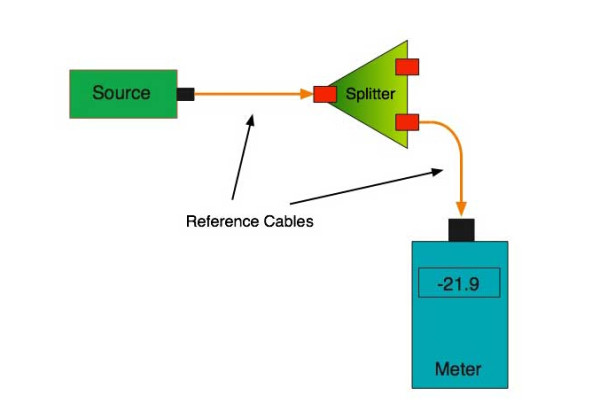
fiber-splitter

What about multiple input and outputs, for example a 2X2 coupler? You would need to test from one input port to the two outputs, then from the other input port to each of the two outputs. This involves a lot of data sometimes but it needs to be tested.

There are other tests that can be performed, including wavelength variations (test at several wavelengths), variations among outputs (compare outputs) and even crosstalk (put a signal on one output and look for signal on other outputs.)

Once installed, the splitter simply becomes one source of loss in the cable plant and is tested as part of that cable plant loss for insertion loss testing. Testing splitters with an OTDR is not the same in each direction.

Other Passive Devices

There are other passive devices that require testing, but the test methods are similar.

Fiber optic switches are devices that can switch an input to one of several outputs under electronic control. Test as you would the splitter as shown above. Switches may be designed for use in only one direction, so check the device specifications to ensure you test in the proper direction. Switches may also need testing for consistency after multiple switch cycles and crosstalk.

Attenuators are used to reduce signal levels at the receiver to prevent overloading the receiver. There is a page on using attenuators that you should read. If you need to test an attenuator alone, not part of a system, use the test for splitters above by using the attenuator to connect the launch and receive cables to see if the loss is as expected.

Wavelength-division multiplexers can be tricky to test because they require sources at a precise wavelenth and spectral width, but otherwise the test procedures are similar to other passive components.

Fiber optic couplers or splitters are available in a wide range of styles and sizes to split or combine light with minimal loss. All couplers are manufactured using a very simple proprietary process that produces reliable, low-cost devices. They are physically rugged and insensitive to operating temperatures. Couplers can be fabricated in custom fiber lengths and/or with terminations of any type.

DK Photonicswww.dkphotonics.com  specializes in designing and manufacturing of high quality optical passive components mainly for telecommunication, fiber sensor and fiber laser applications,such as PLC Splitter, WDM, FWDM, CWDM, DWDM, OADM,Optical Circulator, Isolator, PM Circulator, PM Isolator, Fused Coupler, Fused WDM, Collimator and Polarization Maintaining Components, Pump Combiner, High power isolator, Patch Cord and all kinds of connectors.
DK Photonics:Huawei to invest over $4 billion in fixed broadband technology in 3 years

Telecom network vendor Huawei on Thursday said it will be investing over $4 billion in fixed broadband (FBB) technology research and development over the next three years.

Huawei’s plans to invest significantly in fixed broadband technology reflects a report from Dell’Oro Group that said wireline telecom markets will grow at a CAGR of 3 percent against 1 percent growth for wireless between 2013 and 2018.

In August, Dell’Oro Group said the combined service provider equipment markets will grow at a CAGR of 2 percent between 2013 and 2018 — after recording a CAGR of -1 percent between 2008 and 2013.

Huawei said the $4 billion investment will focus on products and solutions which will support their customers with providing an improved service experience for end users.

Huawei Products and Solutions President Ryan Ding said: “Our investment will further develop technological advances, help customers increase their competitiveness and decrease overall operating costs.”

Existing technologies are changing, next-generation High-Efficiency Video Coding is maturing, 4k panel and content production costs are reducing and the development of the 4k video industry, are all driving new solutions.

Huawei to invest over $4 billion in fixed broadband technology in 3 years

As LTE and 5G deployment continues, construction of high-performance networks which guarantee better customer experience will be expected by telecom operators. Huawei said FBB technologies will be progressed by leveraging big data, data centers and cloud computing to meet their needs.

Tam Dell’Oro, president and founder of Dell’Oro Group, said: “While we believe carriers will continue to enhance their wireless networks, we anticipate carriers will put more emphasis on backhauling traffic which means improving their fixed line networks in the next five years.”

Huawei today said it will innovate Software Defined Networking (SDN), Network Functions Virtualization (NFV) to initiate open broadband networks that help customers simplify operations and management, realize service innovation and improve network efficiency.

For next-generation networks, Huawei will conduct research and develop on new key technologies and architectures for IP and all-optical networks, advancing FBB network development.

Fixed LTE broadband access gains

At present, 1.26 billion households do not have DSL, cable, or fiber-optic broadband. Fixed and mobile telecoms are looking to LTE to make the connection.

“By the end of 2014, there will be 14.5 million residential and commercial premises with fixed LTE broadband access. By 2019, that figure should grow to 123 million,” said Jake Saunders, VP and 4G practice director at ABI Research.

ITU pitches for broadband

ITU, a telecom industry association under the aegis of UN, says more than 40 percent of the world’s people are already online, with the number of Internet users rising from 2.3 billion in 2013 to 2.9 billion by the end of this year.

Over 2.3 billion people will access mobile broadband by end 2014, climbing steeply to a predicted 7.6 billion within the next five years.

ITU says there are now over three times as many mobile broadband connections as there are conventional fixed broadband subscriptions.

Huawei on green telecom

Meanwhile, Eric Xu, Rotating chief executive officer, Huawei, said: “Huawei is committed to socio-economic and environmental sustainability. We leverage our expertise to bridge the digital divide and deliver high-quality digital connectivity for all.”

“We always honor our commitment to supporting secure and stable network operations anytime, anywhere. We contribute to low-carbon economies by helping customers and industries improve productivity and reduce energy consumption,” said Xu at the sixth Global Supplier Sustainability Conference in Shenzhen, China.

DK Photonicswww.dkphotonics.com  specializes in designing and manufacturing of high quality optical passive components mainly for telecommunication, fiber sensor and fiber laser applications,such as PLC Splitter, WDM, FWDM, CWDM, DWDM, OADM,Optical Circulator, Isolator, PM Circulator, PM Isolator, Fused Coupler, Fused WDM, Collimator, Optical Switch and Polarization Maintaining Components, Pump Combiner, High power isolator, Patch Cord and all kinds of connectors.
Differences Between FBT Coupler and PLC splitters

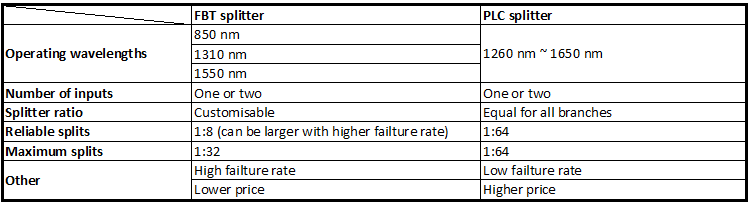
Optical networks require signal being splitted somewhere in design to serve for multiple customers. Splitter technology has made a huge step forward in the past few years by introducing PLC (Planar Lightwave Circuit) splitter. It has proven itself as a higher reliable type of device compared to the traditional FBT (Fused Biconical Taper) splitter. While being similar in size and outer appearance, both types of splitters provide data and video access for business and private customers. However, internally the technologies behind these types vary, thus giving  service providers a possibility to choose a more appropriate solution.

FBT splitter is made out of materials that are easily available, for example steel, fiber, hot dorm and others. All of these materials are low-price, which determines the low cost of the device itself. The technology of the device manufacturing is relatively simple, which has the impact on its price as well. In scenario where multiple splits are needed, the size of the device may become an issue. It is important to keep in mind that splitters are being deployed in the fields either in cabinets or in strand mountings, so the size of device plays a critical role. FBT splitters only support three wavelengths (850/1310/1550 nm) which makes these devices unable to operate on other wavelengths. Inability of adjusting wavelengths makes FBT splitters less customizable for different purposes. Moreover, the devices are to a high extent temperature sensitive, providing a stable working range of -5 to 75 C. In certain areas, such as Scandinavian countries this temperature restrictions may be crucial. The signal processed by FBT splitters cannot be splitted evenly due to lack of management of the signals

PLC splitter manufacturing technology is more complex. It uses semiconductor technology (lithography, etching, developer technology) production, hence it is more difficult to manufacture. Therefore, the price of the device is higher. However, there is a number of advantages the device possesses. The size of the device is compact, compared to FBT splitters, making it suitable for density applications. PLC splitter operates at wider temperature range (-40 to 85 C), allowing its deploying in the areas of extreme climate. The split ratio goes up to 64, providing a high reliability. Furthermore, the signal can be split equally due to technology implemented. A range of wavelengths (1260 – 1650 nm) is provided, so the wavelengths are adjustable. Critical points of the device that might fail are input and output, so the general risk of failure is low.

Differences Between FBT and PLC splitters

 Table 1. FBT and PLC splitter feature comparison

DK Photonicswww.dkphotonics.com  specializes in designing and manufacturing of high quality optical passive components mainly for telecommunication, fiber sensor and fiber laser applications,such as PLC Splitter, WDM, FWDM, CWDM, DWDM, OADM,Optical Circulator, Isolator, PM Circulator, PM Isolator, Fused Coupler, Fused WDM, Collimator, Optical Switch and Polarization Maintaining Components, Pump Combiner, High power isolator, Patch Cord and all kinds of connectors.
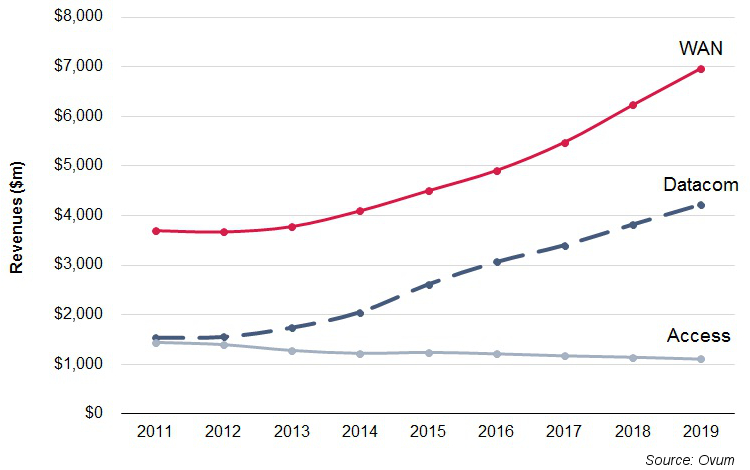
Ovum: Optical components market to grow 8% in 2014 from $6.8 bn in 2013

The global optical components (OC) market is expected to grow 8 percent in 2014 from $6.8 billion in 2013, said Ovum.

In 2013, the OC market increased 3 percent from 2012. Ovum said main growth drivers in 2013 were data communication sales driven by large data centers, 100G coherent demand, and unexpected growth in sales of transceivers for fiber-to-the-antenna applications for 4G build-outs.

“Demand for 100G metro–optimized transmission gear will begin shipments and ramp in 2015. Multiple component vendors introduced components and pluggable optics for 100GHz DWDM in anticipation. Opportunities are also emerging in the data center for high-speed interconnects,” said Daryl Inniss, practice leader for Telecoms Components at Ovum.

In the first quarter of 2014, the optical components market declined 1 percent sequentially and grew 7 percent compared to the year-ago period.  New lower telecom prices were one of the main reasons for the marginal growth in OC on quarter-on-quarter basis.

Ovm said demand for 100G components for coherent transmission in WAN, datacom transceivers at 10 and 40G, and fiber-to-the-antenna transceivers is expected to continue. Traffic continues to increase, and high-speed optics being used in new applications are helping to drive the market forward.

Global-optical-components-market-forecast

The WAN OC segment, which includes components in telecom carriers’ core and metro networks, the largest segment, will grow at a compound annual growth rate (CAGR) of 11 percent to $7 billion in 2019. Demand for 100G components and modules is a big driver for growth in WAN.  Ovum expects strong demand for pluggable coherent transceivers in 2015.

Datacom will be expanding at a 16 percent CAGR to reach $4.2 billion in 2019 — led by demand for 10 and 40G components in the early years and then 100G in the later years driven by the availability of server ports supporting data rates greater than 10G.

Access — including CATV, FTTx and transceivers for the fiber-to-the-antenna application — will decline at 2 percent CAGR to $1.1 billion in 2019. The decline will be driven by the FTTx application, where volumes are nearly constant through the forecast period but price declines are projected to pull down revenues.


DK Photonicswww.dkphotonics.com  specializes in designing and manufacturing of high quality optical passive components mainly for telecommunication, fiber sensor and fiber laser applications,such as PLC Splitter, WDM, FWDM, CWDM, DWDM, OADM,Optical Circulator, Isolator, PM Circulator, PM Isolator, Fused Coupler, Fused WDM, Collimator, Optical Switch and Polarization Maintaining Components, Pump Combiner, High power isolator, Patch Cord and all kinds of connectors.
Huawei, Rostelecom collaborate on FTTH distribution boxes—DK Photonics

Huawei says it has collaborated with Russian service provider Rostelecom to develop floor distribution boxes (FDBs) for use in Rostelecom’s flexible fiber to the home (FTTH) deployments. The FDBs will help improve the efficiency of the operator’s FTTH deployments, particularly in sparsely populated areas, Huawei says.

Rostelecom is under a mandate from the Russian government to connect 13 million CWDM Module users by 2015, Huawei says. This task is complicated by the fact that much of the operator’s footprint covers rural areas.

To improve deployment efficiency, Huawei says it recommended what it calls “the thin-covered network deployment model.” According to the model, fiber-optic networks are constructed to user access points and the FDBs, the latter of which are used as the interface between the outside plant and the inside plant. As the network expands and more users are connected, pre-made drop cables can be used for plug-and-play, quick service provisioning.

The customized FDBs were designed for success-based deployment. Rostelecom can deploy FDBs that provide access to a single user, then add connections as many as four or eight users as take rates improve. Technicians can complete the expansion in one minute without the use of tools, Huawei says.

Huawei and Rostelecom will further collaborate on other network elements, including the closure, optical splitter, and fiber distribution terminal (FDT), the technology provider added.

For more information on FTTx products, visit the DK Photonics Website.

DK Photonicswww.dkphotonics.com  specializes in designing and manufacturing of high quality optical passive components mainly for telecommunication, fiber sensor and fiber laser applications,such as PLC Splitter, WDM, FWDM, CWDM, DWDM, OADM,Optical Circulator, Isolator, PM Circulator, PM Isolator, Fused Coupler, Fused WDM, Collimator, Optical Switch and Polarization Maintaining Components, Pump Combiner, High power isolator, Patch Cord and all kinds of connectors.
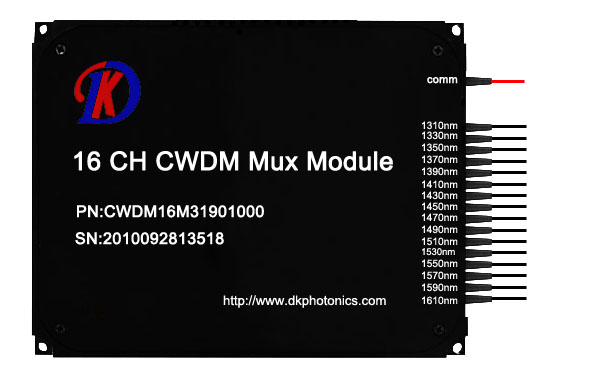
What Is a Fiber-Optic Multiplexer?–DK Photonics

What Is a Fiber-Optic Multiplexer?

A fiber-optic multiplexer is a device that processes two or more light signals through a single optical fiber, in order to increase the amount of information that can be carried through a network. Light wavelengths are narrow beams that ricochet through reflective optical tubing, sometimes over long distances, to provide instantaneous electronic signal processing at the speed of light. Multiplexers work by increasing a fiber’s transmission capacity using different techniques and light source technologies. When the signal arrives at its destination, a demultiplexer separates the data streams. Using a multiplexer also allows data to be sent farther, more securely, and with less electromagnetic and radio frequency interference.

16CH CWDM
16CH CWDM

Also known as a mux, the fiber-optic multiplexer saves time and cost by squeezing more information through the optical network pathway. It is possible to split signals by varying the schedule or period of each transmission. Time Division Multiplexing (TDM) combines multiple signals by rapidly alternating between them so that only one is transmitting at any given time. Statistical Time Division Multiplexing (STDM) assigns each signal a specific time slot in order to optimize bandwidth usage. Further techniques include divisions of wavelength and frequency.

Wavelength Division Multiplexing (WDM) utilizes the total available pass band of an optical fiber. It assigns individual information streams different wavelengths, or portions of the electromagnetic spectrum. Similarly, Frequency Division Multiplexing (FDM) assigns each signal a different frequency. Carrier frequencies contain the signal while unused guard frequencies provide buffering to reduce interference. This helps minimize audible and visual noise and preserves the integrity of the original signal throughout the network.

Fiber-optic multiplexer technology serves single-mode and multimode optical fibers with multichannel rack mount or standalone units. This makes mixing channels with different configurations possible for a range of interface combinations. These devices provide stronger, more reliable transmissions in areas that have a lot of electromagnetic, radio frequency, or lightning interference.

As technology improves and information needs grow to fill the capacities of existing networks, equipment such as the fiber-optic multiplexer lessens the need to upgrade the fiber-optic infrastructure itself. Multiplexers permit new configurations of transmission protocols by increasing the amount of wavelengths or frequencies of light signals. By upgrading repeaters and terminal equipment, existing network transmission capacity can expand with demand.

Used by cellular carriers, Internet service providers, public utilities, and businesses, fiber-optic multiplexer technology extends the reach and power of telecommunications technologies. Network management systems allow for system service and maintenance, and provide for security, fault management, and system configuration. With advantages like lower costs and longer life expectancies, current fiber-optical networks are aided by improvements in multiplexing technology, and may provide light speed data transmission well into the future.

DK Photonicswww.dkphotonics.com  specializes in designing and manufacturing of high quality optical passive components mainly for telecommunication, fiber sensor and fiber laser applications,such as PLC Splitter, WDM, FWDM, CWDM, DWDM, OADM,Optical Circulator, Isolator, PM Circulator, PM Isolator, Fused Coupler, Fused WDM, Collimator, Optical Switch and Polarization Maintaining Components, Pump Combiner, High power isolator, Patch Cord and all kinds of connectors.
 

Free Space Optics Global Market Forecast –DK Photonics

According to ElectroniCast, the worldwide value of FSO link devices in stationary non-military/aerospace applications was $33.49 million in 2013…

Aptos, CA (USA) – January 24, 2014 —ElectroniCast Consultants, a leading market research consultancy, today announced the release of a report presenting their market analysis and forecast of Free Space Optics (FSO) communication links used in non-military/aerospace applications.

The global consumption of fixed-location (stationary) Transmitter/Receiver (T/R) links (pairs) used in non-military/ aerospace Free Space Optic system equipment was $33.49 million in 2013, up 11 percent from $29.83 million in 2012.  Free Space Optic (FSO) Transmitters and Receivers (pairs) used in link equipment with a range capability of less than 500 meters or less led in relative market share in 2013 with a global consumption value of $23.06 million.

According to the Free Space Optics Global Market Forecast & Analysis (January 2014), FSO is a line-of-sight (LOS) technology that uses directed laser beams, which provide optical bandwidth Transmitters and Receivers to link voice, video, and data intelligent transfer.  A single FSO link product (from point A to point B) often may incorporate multiple transmitters along with receiver/s to ensure adequate performance, in case of interference.

Free Space Optic communication links can be installed along railroad/subway tracks, tunnels, airport terminals, parking lot/structures or other major un-obstructed right-of-way (ROW); outdoors on building rooftops (building-to-building and/or campus), exterior walls, towers, indoors (aimed out a window), or any combination; however, a direct line-of-sight and appropriate distance are required to enable a Transmitter/Receiver Link between two points (point-to-point).

FSO-based products accommodate Ethernet-based protocols, SONET/SDH, ATM, FDDI and other standard and proprietary protocols. Products can be used for metropolitan (Metro) network extension; DWDM services, access/last mile, wireless backhaul, disaster recovery (testing and communications), storage area networks (SANs) and LAN/first mile/FTTx, and an almost endless list of other solutions.

The increase in the consumption of FSO links in the America region will be attributed to not only continued upgrades and network facilitation in the United States and Canada, but partly from the accelerating economic growth of major cities in Latin America.  Other market dynamics in the American region are increases in communication links needed for growing infrastructures, such as mass transit, security systems, broadcast and telecommunications.

European inner-city urban areas typically are difficult for wire-lines, including optical fiber cable installations; therefore, this fact promotes FSO or other wireless solutions.  The APAC region has advanced communication technology deployed especially in Japan; however, other countries, such as Australia, China and India, are not as advanced in campus-wide and metropolitan optical communication deployment.

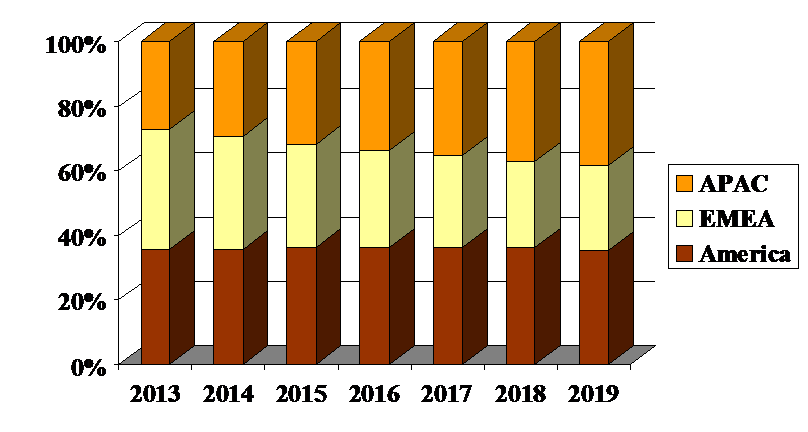
The APAC region has rapidly expanding market opportunities and therefore, our forecast shows the region with the fastest growth (2013-2019), with the region taking over the leadership position later on in the forecast period.

According to ElectroniCast, the APAC region is forecast to eventually take the lead in terms of relative market share of non-military/aerospace FSO-Links…

Non-Military/Aerospace

FSO Global Consumption Value Market Share (%), By Region

FSO Global Consumption Value Market Share

Source: ElectroniCast Consultants

DK Photonics – www.dkphotonics.com  specializes in designing and manufacturing of high quality optical passive components mainly for telecommunication, fiber sensor and fiber laser applications,such as PLC Splitter, WDM, FWDM, CWDM, DWDM, OADM,Optical Circulator, Isolator, PM Circulator, PM Isolator, Fused Coupler, Fused WDM, Collimator, Optical Switch and Polarization Maintaining Components, Pump Combiner, High power isolator, Patch Cord and all kinds of connectors.
Fiber Optic Sensors Global Market Forecast- DK Photonics

According to ElectroniCast, the combined use of Continuous Distributed and Point fiber optics sensors will reach $4.33 Billion in 2018…

Aptos, CA (USA) – February 14, 2014 —ElectroniCast Consultants, a leading market/technology forecast consultancy, today announced the release of their market forecast and analysis of the global consumption Fiber Optic Point Sensors and Continuous Distributed Fiber Optics Sensor systems.

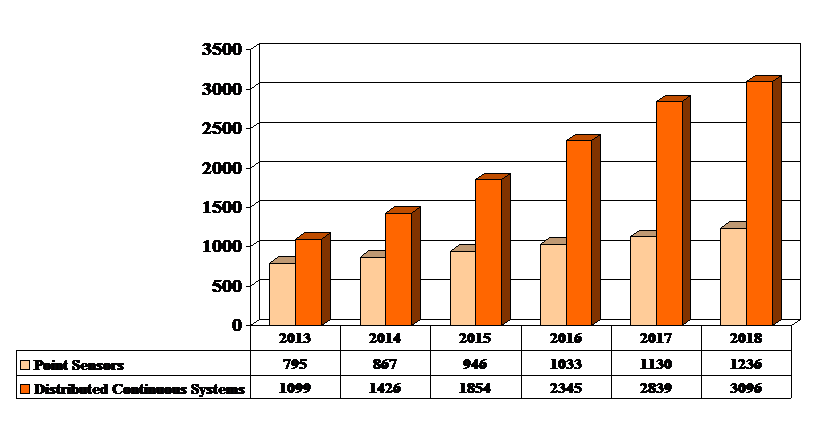
According to ElectroniCast, the consumption value is forecast to increase at an impressive 18% per year from $1.89 billion in 2013 to $4.33 billion in 2018.  Market forecast data refers to consumption for a particular calendar year; therefore, this data is not cumulative data.

Continuous Distributed fiber optic sensor systems involve the optic fiber with the sensors embedded with the fiber.  ElectroniCast counts each Point fiber optic sensor as one unit; however, the volume of Distributed Continuous fiber optic sensors is based on a complete optical fiber line and associated other components, which are defined as a system.

The use of Distributed Continuous fiber optic sensors in the Military/Aerospace/Security application category maintains the lead in 2014, followed by the Petrochemical/ Energy sector.  The Civil Engineering/Construction sector, which includes continuous fiber sensors used in Structural Health Monitoring (SHM) as well as other concerns in buildings, bridges, tunnels, towers, and other structures, is also forecast for strong growth.  Inspection and quality control frequently constitute the largest portion of production costs for many industries.

“There is a growing need for improved measurement solutions, which offer higher precision, speed and accuracy and provide better in-process measurement of moving objects, resulting in lower costs for better products.  Relatively speaking, the Manufacturing/ Factory segment tends to favor point sensors instead of distributed fiber systems,” stated Stephen Montgomery, Director of the Fiber Optics Components group at ElectroniCast Consultants.

“The Biomedical/ Science sector is a relatively minor user of Distributed Continuous fiber optic sensors, in terms of consumption value, since the length of optical fiber is (very) short versus the other applications; therefore the average selling prices for the distributed continuous fiber optic sensor systems are low compared to the larger (longer length of optical fiber) distributed continuous fiber optic sensor systems used in other applications. The consumption value of Distributed Continuous fiber optic sensor systems is forecast to grow at 23% per year from $1.099 billion in 2013 to $3.096 billion in the year 2018,” Montgomery added.

DATA FIGURE

According to ElectroniCast, the consumption value of fiber optic sensors (continuous distributed systems + Point-types) will increase from $1.89 billion in 2013 to $4.33 billion in 2018.

Fiber Optic Sensor Global Consumption Market Forecast

Point vs. Distributed Continuous
(Value Basis, $Million
)

Fiber Optic Sensor Global Consumption Market Forecast


Note: Market forecast data refers to consumption for a particular calendar year; therefore, this data is not cumulative data.

DK Photonicswww.dkphotonics.com  specializes in designing and manufacturing of high quality optical passive components mainly for telecommunication, fiber sensor and fiber laser applications,such as PLC Splitter, WDM, FWDM, CWDM, DWDM, OADM,Optical Circulator, Isolator, PM Circulator, PM Isolator, Fused Coupler, Fused WDM, Collimator, Optical Switch and Polarization Maintaining Components, Pump Combiner, High power isolator, Patch Cord and all kinds of connectors.
Planar Lightwave Circuit Splitters Market Forecast

Fiber-to-the-Home deployment dominates the PLC splitter marketplace…

Fiber-to-the-Home deployment dominates the PLC splitter marketplace…

Aptos, CA (USA) – February 20, 2014  — ElectroniCast Consultants, a leading market/technology consultancy, today announced the report release of their market forecast of the global consumption of Planar Lightwave Circuit (PLC) splitters used in Fiber Optic Communication Networks.

According to the ElectroniCast market study, the consumption value of component-level (compact device) PLC splitters reached $529.6 million in 2013. PLC splitters will continue to contribute an important role in Fiber to the Home (FTTH) networks by allowing a single passive optical network (PON) interface to be shared among many subscribers.  PLC splitters are available in compact sizes; therefore, they can be used in aerial apparatus, pedestals or in-ground as well as rack mount or other module-based value-added product. Installation is simple using a variety of connector types or fusion splicing.

“The PON-based Fiber-to-the-Home network application dominates the worldwide PLC splitter consumption value in 2014,” stated Stephen Montgomery, Director of the Fiber Optics Components group at ElectroniCast Consultants.

“The American region is forecast for flat annual growth (just over 1%); however, the EMEA region is set for 7% per year and the APAC region is forecast to increase at 15% per year, for the component-level PLC splitters, during the 2013-2018 timeframe cover by the ElectroniCast study,” Montgomery added.

DK Photonics – www.dkphotonics.com  specializes in designing and manufacturing of high quality optical passive components mainly for telecommunication, fiber sensor and fiber laser applications,such as PLC Splitter, WDM, FWDM, CWDM, DWDM, OADM,Optical Circulator, Isolator, PM Circulator, PM Isolator, Fused Coupler, Fused WDM, Collimator, Optical Switch and Polarization Maintaining Components, Pump Combiner, High power isolator, Patch Cord and all kinds of connectors.

Comparation Between EPON and GPON

With the continuous progress of science and technology, the Internet has gradually gone into the homes of the ordinary people, and the speed of broadband has increasingly become the topic of people in the entertainment and work often, from narrowband dial-up to broadband Internet, and then the fiber access Internet, broadband network, the rapid pace of PON technology gradually come to the front. Currently, there are two quite compelling PON standard has been officially released, which are GPON standard developed by the ITU / FSAN and EPON standard developed by IEEE 802.3ah working group. PON technology has been no doubt the ultimate solution for the future FTTH era. EPON and GPON who will the dominant FTTH tide has become a new hot debate. What’s the difference between EPON and GPON?

GPON and EPON Differences

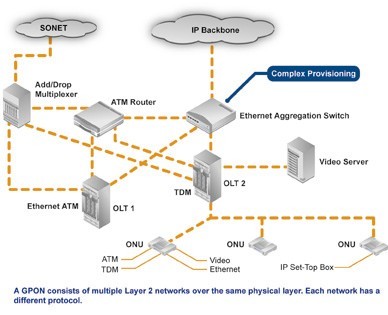
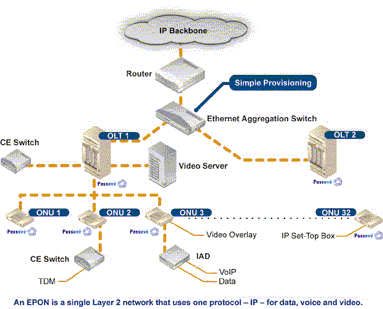
Perhaps the most dramatic distinction between the two protocols is a marked difference in architectural approach. GPON provides three Layer 2 networks: ATM for voice, Ethernet for data, and proprietary encapsulation for voice. EPON, on the other hand, employs a single Layer 2 network that uses IP to carry data, voice, and video.

A multiprotocol transport solution supports the GPON structure (Figure 1). Using ATM technology, virtual circuits are provisioned for different types of services sent from a central office location primarily to business end users. This type of transport provides high-quality service, but involves significant overhead because virtual circuits need to be provisioned for each type of service. Additionally, GPON equipment requires multiple protocol conversions, segmentation and reassembly (SAR), virtual channel (VC) termination and point-to-point protocol (PPP).

Figure 1: Diagram showing a typical GPON network.

EPON provides seamless connectivity for any type of IP-based or other “packetized” “communications” (Figure 2). Since Ethernet devices are ubiquitous from the home network all the way through to regional, national and worldwide backbone networks, implementation of EPONs can be highly cost-effective. Furthermore, based on continuing advances in the transfer rate of Ethernet-based transport — now up to 10 Gigabit Ethernet — EPON service levels for customers are scalable from T1 (1.5 Mbit/s) up through 1 Gbit/s.

Figure 2: Diagram showing a typical EPON network.

Upstream Bandwidth

Subtracting the various system run overhead from the total bandwidth of the system uplink transmission is the upstream available bandwidth. It has a great relationship with the number of the ONU contained in the system, DBA (Dynamic Bandwidth Allocation) algorithm polling cycle, the type of bearer services, as well as the various business proportion. EPON and GPON are broadband access technology, hosted business IP data services. Below we will calculate the uplink the beared pure IP services available bandwidth of EPON and GPON that contain 32 ONUs, fiber optic coupler,the case of polling period 750s.

EPON

EPON upstream rate is 1.25 Gbit/s. Because the 8B/10B line coding, each 10bit are 8bit valid data, so its effective upstream transmission bandwidth is 1 Gbit/s. EPON upstream overhead of running the system and its proportion of the total bandwidth are as following:

1. Used for the the burst reception of physical layer overhead: about 3.5%;

2. Ethernet frame encapsulation overhead: about 7.4%;

3. MPCP (Multi-Point Control Protocol) and OAM operation and management of maintenance protocol overhead: about 2.9%;

4. DBA algorithm resulting in the remaining time slots (that is not sufficient to transfer a complete Ethernet frame time slot) wasted: about 0.6%;

5. EPON upstream total overhead is all of the above about 144 Mbit/s, the available bandwidth is about 856 Mbit/s.

GPON

GPON supports a variety of rate levels, has asymmetric rate that downlink is 2.5Gbps or 1.25Gbps, the upgoing is 1.25Gbps or 622 Mbps. NRZ encoding the uplink total bandwidth for 1.244 Gbit/s, GPON upstream overhead of running the system as following:

1. The proportion of its total bandwidth is used for the the burst reception of physical layer overhead: about 2.0%;

2. GEM (GPON encapsulation method) frame and the Ethernet frame encapsulation overhead: about 5.8%;

3. The PLOAM (physical layer operation, management and maintenance) protocol overhead: about 2.1%;

4. Remaining slots of the DBA algorithm introduced the additional encapsulation overhead: about 0.8%.

5. GPON upstream total overhead is all of the above about 133 Mbit/s, the available bandwidth about 1111 Mbit/s.