WDM-PON technology-DK Photonics

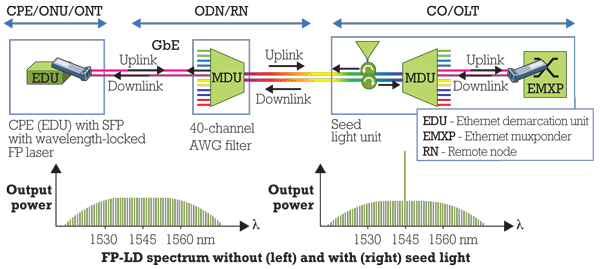
WDM-PON provides the dedicated bandwidth of a point-to-point network and the fiber sharing inherent in PONs. The architecture is somewhat similar to that of EPON and GPON; instead of the power-splitter approach used in TDM-PON architectures, WDM-PON uses an arrayed waveguide grating (AWG) filter that separates the wavelengths for individual delivery to the subscriber ONUs (see Figure 1).

A simple, plug-and-play implementation is based on wavelength-locked or tunable lasers. Self-tuning “colorless” ONUs can be used at the subscriber sites to simplify inventory and spare-part handling. Colorless optics not only simplify operations, but also reduce deployment costs, since they don’t need the expensive wavelength-stability components that traditional fixed and tunable optics require. There are multiple approaches to the colorless ONU technology.

In one approach, the wavelength of the ONU transmitter is controlled by injection of a “seed” signal into the transmitter (e.g., a wavelength-locked Fabry-Perot laser or reflective semiconductor optical amplifier). The seed signal injected into the transmitter could come from broadband ASE light sliced through the filters in the system or from a DFB laser array. In a self-seeding version of this approach, the seed light is provided by feedback of broadband light from the transmitter itself. The passive filtering of the seed light in the remote node determines the wavelength of the ONU transmitter.

In a different approach, the colorless ONU contains a singlemode optic coupler wavelength-tunable laser, which is able to tune to the appropriate wavelength that matches the remote node filter port.

Below 10-Gbps channel bit rates, the injection-seeded method provides a cost-efficient approach. As an example, a wavelength-locked Fabry-Perot transmitter can be integrated into an MSA SFP pluggable form-factor module, which enables the use of third-party CPE devices. A modified EDFA gain block in a 70×90 MSA form factor could be used to generate the broadband ASE light that’s used as a seed signal in the system.

At 10-Gbps bit rates, tunable-laser technology offers an alternative to the injection-seeded approach. The tunable-laser technology developed for the metro/long-haul market has matured significantly over the past couple of years and is able to give a good cost-per-bit ratio when high capacity is needed.

If the WDM-PON system is properly designed, then it’s possible to mix different transmission technologies. By following certain design rules during the installation of the WDM-PON system, it’s possible to allow step-wise channel upgrades to higher bit rates when the demand arises. These design rules ensure that channel OSNR requirements will be met in the presence of reflections and that inter-channel crosstalk is avoided. The result is an open and flexible access network that can support many applications and services over the same infrastructure. WDM-PON thus becomes an optical option for the access network as and where it makes sense.

Given its ability to help service providers cope with current bandwidth demands as well as the next potential broadband access bottleneck, WDM-PON100GHz DWDM Module is becoming an important technology to consider in terms of its benefits and market timing. As with any emerging technology, service providers need to consider the optimal strategy for initial deployment of WDM-PON. That includes how they could use WDM-PON for additional network applications as the technology matures and its costs come down.

 WDM-PON technology

WDM-PON technology

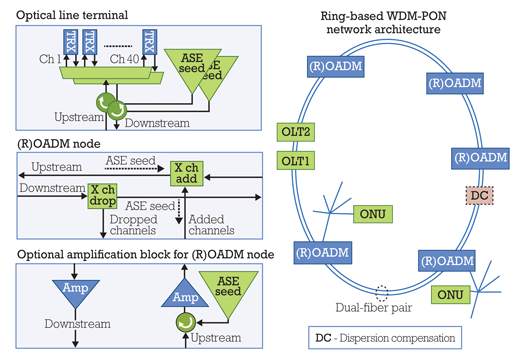
FIGURE 2. Architectural scenario explored in the collaboration between Transmode and Deutsche Telekom Hochschule für Telekommunikation.

The latest generations of WDM-PON systems are now gaining traction with operators around the globe for field deployment, lab trials, and evaluations. It’s clearly the early stage of WDM-PON deployments, but progress has started and 2014 looks to be a pivotal year for the technology.

WDM-PON is a key component in next generation access(1)

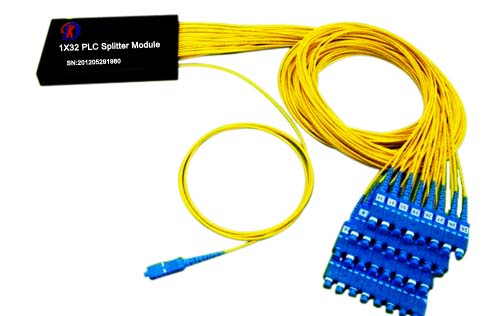
Many industry analysts believe that the increasing requirements for bandwidth scalability, quality of service, and support of the emerging traffic patterns required by video and broadcast standards will make copper networks insufficient for many high-bandwidth services in the future. Fiber availability is not universal, and the economics of new fiber deployments are often challenging; nevertheless, fiber will undoubtedly push deeper into access networks to support business services, mobile backhaul/fronthaul, multitenant buildings/fiber to the cabinet, and in some cases fiber to the home (FTTH), too. Yet todays fiber-based approaches, including TDM-PON/PLC Splitter and active point-to-point Ethernet, probably won’t meet the likely requirements of the next generation of bandwidth-intensive traffic, either.

WDM-PON is a passive optical networking approach — currently being developed by several companies — that can be used to more adequately address these challenges over fiber-based networks. A WDM-PON design can be used to separate optical-network units (ONUs) into several virtual point-to-point connections over the same physical infrastructure, a feature that enables efficient use of fiber compared to point-to-point Ethernet and offers lower latency than TDM-based approaches. A notable advantage of this approach is the combination of high capacity per user, high security, and longer optical reach. WDM-PON therefore is highly suitable for applications such as mobile backhaul or business Ethernet service provision.

Thus WDM-PON is poised to become the disruptive next generation access architecture. It will enable high-speed access for businesses, mobile backhaul, and eventually FTTH. WDM-PON also will enable operators to build converged networks and consolidate existing access networks, including potentially eliminating central offices to reduce cost while boosting performance.

There are several types of WDM-PON systems under development. They all have in common the use of passive, temperature-hardened DWDM optical filters in the remote node and colorless ONUs.

Basic WDM-PON architecture

FIGURE 1. Basic WDM-PON architecture.

DK Photonics – www.dkphotonics.com specializes in designing and manufacturing of high quality optical passive components mainly for telecommunication, fiber sensor and fiber laser applications,such as High Power Isolator,1064nm Components,PM Components,Pump Combiner,Pump Laser Protector,which using for fiber laser applications.Also have Mini-size CWDM, Optical Circulator, PM Circulator,PM Isolator, Fused Coupler,Mini Size Fused WDM.More information,please contact us.

Planar Lightwave Circuit Splitters Market Forecast

Fiber-to-the-Home deployment dominates the PLC splitter marketplace…

Fiber-to-the-Home deployment dominates the PLC splitter marketplace…

Aptos, CA (USA) – February 20, 2014  — ElectroniCast Consultants, a leading market/technology consultancy, today announced the report release of their market forecast of the global consumption of Planar Lightwave Circuit (PLC) splitters used in Fiber Optic Communication Networks.

According to the ElectroniCast market study, the consumption value of component-level (compact device) PLC splitters reached $529.6 million in 2013. PLC splitters will continue to contribute an important role in Fiber to the Home (FTTH) networks by allowing a single passive optical network (PON) interface to be shared among many subscribers.  PLC splitters are available in compact sizes; therefore, they can be used in aerial apparatus, pedestals or in-ground as well as rack mount or other module-based value-added product. Installation is simple using a variety of connector types or fusion splicing.

“The PON-based Fiber-to-the-Home network application dominates the worldwide PLC splitter consumption value in 2014,” stated Stephen Montgomery, Director of the Fiber Optics Components group at ElectroniCast Consultants.

“The American region is forecast for flat annual growth (just over 1%); however, the EMEA region is set for 7% per year and the APAC region is forecast to increase at 15% per year, for the component-level PLC splitters, during the 2013-2018 timeframe cover by the ElectroniCast study,” Montgomery added.

DK Photonics – www.dkphotonics.com  specializes in designing and manufacturing of high quality optical passive components mainly for telecommunication, fiber sensor and fiber laser applications,such as PLC Splitter, WDM, FWDM, CWDM, DWDM, OADM,Optical Circulator, Isolator, PM Circulator, PM Isolator, Fused Coupler, Fused WDM, Collimator, Optical Switch and Polarization Maintaining Components, Pump Combiner, High power isolator, Patch Cord and all kinds of connectors.

62.5/125 um Vs. 50/125um Multimode fiber Information

We have created this page to illustrate the very basic differences between 62.5 and 50/125 multimode fiber in selecting a patch cable for your existing cable plant.

62.5/125 um Vs. 50/125um Multimode fiber


62.5/125 um Vs. 50/125um Multimode fiber

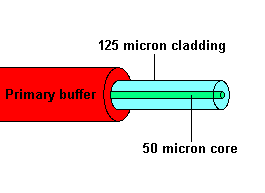
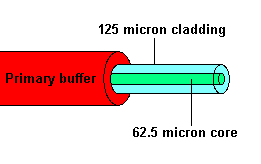
The key thing to remember is to always use a patch cable of the same type as the cable that you are connecting to. It is virtually impossible to tell the difference between the two fiber types (62.5 and 50/125) by looking at the bare fiber* or the connectors*. Usually, this information will be written on the cable’s jacket.

The photos above illustrate that the outer diameters of the two fiber types are the same. What is different is the size of the center light carrying core of the fiber. You cannot see the fiber’s core without a microscope*. Therefore, you must rely on the writing that is on the fibers jacket to determine what type is.

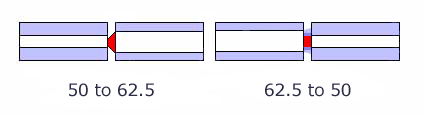
Severe losses of light can occur when you try to match 50/125 and 62.5/125 fiber, as the illustration on the left shows.

62.5/125 um Vs. 50/125um Multimode fiber

* CAUTION: Never look directly into a fiber cable’s end face or into the ferrule of a connector (with fiber present) as there may be dangerous laser light present.

NOTE: This page was designed to help you know the difference between 62.5 and 50/125 fiber for the purpose of purchasing patch cables and products to connect to existing installed cabling. This page was not designed to provide information on choosing between the two types fiber for new installations.

What is Pump Laser Protector, Where is the Pump Laser Protector use?

The Pump Laser Protector (also called Pump Protection Filters) is a passive component which allows maximum transmission from a discrete fibre-coupled pump laser diode and blocks parasitic signals around the centre wavelength of the laser from being reflected back into the laser.

Pump Laser Protector
Multimode Pump Laser Protector -10~30W

Single-emitter laser diodes are highly regarded for their long term reliability. However, these devices are very sensitive to backward propagating light within the delivery fiber. Backward power imaged onto the diode material, as small as 5% of the pump diode output, can cause accelerated diode degradation and, in the majority of cases, catastrophic failure.That is why we need Pump Laser Protector.

DK Photonics offers filter technology that provides protection to pump diodes under these conditions (up to 50 dB Backward Signal Attenuation). Splicing these filters to the pump output fiber rejects unwanted light before it reaches the diode.

Multimode Pump Protection filters are available for a wide range of standard light emitting diodes. Fiber pigtails are 105/125 micron, with both 0.15 and 0.22 NA cores and 50/125 or 62.5/126 MM fiber available. Operating wavelengths cover the majority of diode laser lines (915 nm, 940 nm, 960 nm and 976) and maximum power handling is 25W without water-cooling.DK Photonics recently released a new type of Pump Laser Protector up to 200W handling power with water-cooling technology. And also have SingleMode Pump Laser Protector with Hi1060 fiber for 976nm fiber laser.

If you do not see a Pump Laser Protector from the standard configurations that meets your needs, we welcome the opportunity to review your desired specification and quote a filter best suited to your application. Different pump/rejection wavelengths or fiber pigtail can be accommodated.

DK Photonics – www.dkphotonics.com specializes in designing and manufacturing of high quality optical passive components mainly for telecommunication, fiber sensor and fiber laser applications,such asDK Photonics' promotion products including:High Power Isolator,1064nm Components,PM Components,Pump Combiner,Pump Laser Protector,which using for fiber laser applications.Also have Mini-size CWDM, Optical Circulator, PM Circulator,PM Isolator, Fused Coupler,Mini Size Fused WDM.More information,please contact us.

What is Optical Circulator? What is the application of Optical Circulator?

What is Optical Circulator?

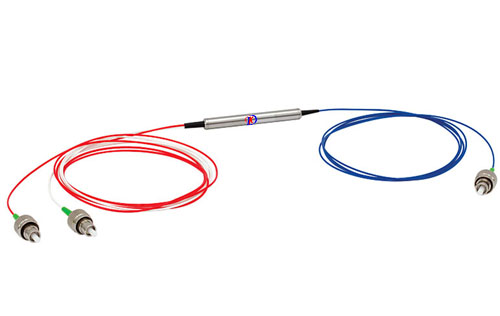
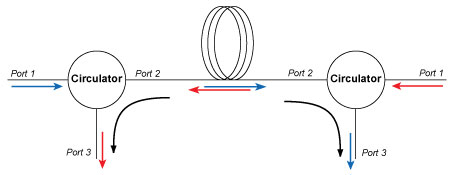
An optical circulator is a special fiber-optic component that can be used to separate optical signals that travel in opposite directions in an optical fiber, analogous to the operation of an electronic circulator. An optical circulator is a three-port device designed such that light entering any port exits from the next. This means that if light enters port 1 it is emitted from port 2, but if some of the emitted light is reflected back to the circulator, it does not come out of port 1, but instead exits from port 3.

3 port Optical Circulator
   3 port Optical Circulator
The application of Optical Circulator

Fiber optic circulators are non-reciprocal optics, which means that changes in the properties of light passing through the device are not reversed when the light passes through in the opposite direction. This can only happen when the symmetry of the system is broken, for example by an external magnetic field. A Faraday rotator is another example of a non-reciprocal optical device.


The Configuration of optical circulator

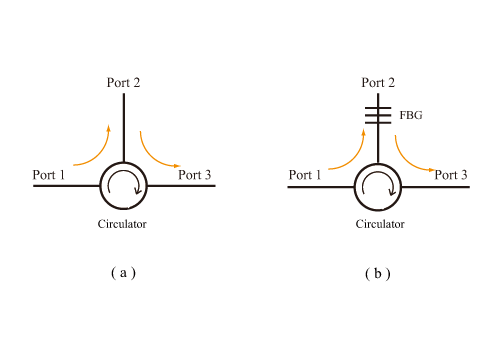
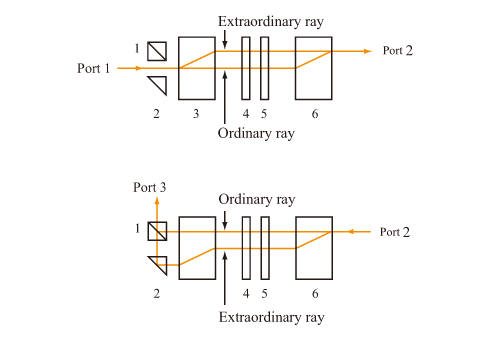
As shown in Fig.2(a), an optical circulator typically has three input or output ports. The signal light input into the port 1 is output from the port 2. The signal light input into the port 2 is output from the port 3. The optical circulator is often used with adding an FBG at the port 2 as shown in Fig.2(b). For reference, a composition of optical circulator is shown in Fig.3.

Optical circulator Schematic of operation and application

Figure 2: Optical circulator. (a) Schematic of operation and (b) application.

Configuration of optical circulator

Figure 3: Configuration of optical circulator. 1: Poparization beam splitter (PBS), 2: reflection prism, 3 and 6: Birefringence crystal, 4: Faraday rotator, 5: half-wave plate


The application of Optical Circulator

An optical circulator is frequently used for an optical time domain reflectometer (OTDR), an optical add-drop multiplexer (OADM) and a dense wavelength devision multiplexing (DWDM) network using an FBG, and a pulse stretcher, a pulse compressor, and a disprersion compensator using a chirped FBG. Optical Circulators can be used to achieve bi-directional transmission over a single fiber. Because of its high isolation of the input and reflected optical powers and its low insertion loss, optical circulators are widely used in advanced communication systems and fiber-optic sensor applications.


Read more related articles :

Optical Circulator

Optical Isolators Global Market Forecast

According to ElectroniCast, the Asia Pacific Region leads in the use of optical isolators…

ElectroniCast Consultants, a leading market research & technology forecast consultancy addressing the fiber optics communications industry, today announced the release of a new market forecast of the global consumption of optical isolators in optical communication and specialty applications.

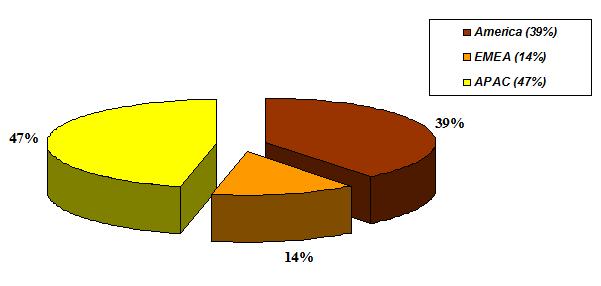
According to ElectroniCast, the Asia Pacific region (APAC), region held the lead in terms of relative market share consumption volume (quantity/number of units) of optical isolators in 2012, with 47 percent; however the Asia Pacific region (APAC), pushed along by the telecommunication category in the People’s Republic of China. The consumption of optical isolators in the APAC region is forecast to nearly triple (3x) during the 2012-2017 time frame.

Optical isolators are passive devices that allow light to be transmitted in only one direction. They are most often used to prevent any light from reflecting back down the optical fiber, as this light would enter the source and cause backscattering and feedback problems. This is especially important for high data rate transceivers and transponders, or those devices requiring long span lengths between transceiver pairs.

Optical isolators are used in many applications in commercial, industrial, and laboratory settings.  They are reliable devices when used in conjunction with fiber optic amplifiers, fiber optic ring lasers, fiber optic links in cable TV/multimedia applications, and high-speed/ DWDM and coherent fiber optic telecommunication communication systems, laboratory R&D, sensors, gyro-systems, test/instrumentation measurement quality assurance applications in automation of manufacturing processes and several others.

ElectroniCast estimates that the Telecommunication applications held 85% of the relative market share of the worldwide consumption volume of optical isolators in 2012.

According to ElectroniCast, 13.4 million optical isolators were used in 2012…

2012 – Optical Isolator Global Volume (Quantity) Market Share (%),

By Region, 13.4 Million Units

optical isolator

DK Photonicswww.dkphotonics.com  specializes in designing and manufacturing of high quality optical passive components mainly for telecommunication, fiber sensor and fiber laser applications,such as PLC Splitter, WDM, FWDM, CWDM, DWDM, OADM,Optical Circulator, Isolator, PM Circulator, PM Isolator, Fused Coupler, Fused WDM, Collimator, Optical Switch and Polarization Maintaining Components, Pump Combiner, High power isolator, Patch Cord and all kinds of connectors.

Application of fiber optic high power isolator and some mutual problems about its production process

1 introduction

Semiconductor lasers, optical amplifiers and optical fiber lasers from the connector, fusion point, filter the reflection light is very sensitive, and may cause performance deterioration and even damaged, requiring a optical isolator to prevent the reflection of light. The optical isolator is permitted only light along one direction through and in the opposite direction blocks light through the optical passive devices. In the optical fiber communication, optical fiber reflection light through the optical isolator can be a good isolation. In the fiber laser applications, optical isolators are usually used in the optical path to avoid the light path of the light source, the echo on the pumping source and other light emitting device causes interference and damage. Isolators’s isolation represents the optical isolator to echo the isolation (blocking) ability.

2 optical isolator principle

Optical isolator using magnetic optical crystal Faraday effect ( also known as the Faraday effect ). In 1845, Faraday first observed with optical material under the action of magnetic field to make the material in the direction of polarization rotation, therefore often called the Faraday effect. In Faraday effect, the rotation of the polarization direction direction and magnetic field, and the orientation of the light transmitting is independent of the forward and reverse, and we usually in the index of refraction, reflection phenomena seen in the reversibility of optical path difference. Along the magnetic field direction of transmission line polarized, the polarization direction rotating angle θand magnetic field strength of B and L is proportional to the product of the length of the material, the proportion coefficient is what we often say that the Wilde constant. Optical isolator based on polarization characteristics can be divided into polarization-independent and polarization dependent type. These two kinds of isolators are used with the Faraday effect in magneto-optic crystal, Faraday magnetic medium in 1~2μ m wavelength range usually adopts the optical loss low yttrium iron garnet ( YIG ) single crystals. Model of input and output of the fiber optical isolator has fairly good performance, the minimum insertion loss of approximately 0.5 dB, the isolation of up to 35~ 60 dB, a maximum of 70 dB.   The optical isolator using most still is polarization independent type, its principle is shown in Figure 1, using the forward and reverse transmission optical path is inconsistent, it is this time signal transmission is not reversible, thereby forming isolation. The typical structure of only four major components: the magnetic ring, a Faraday rotator, two pieces of LiNbO3 wedge angle piece, with a pair of fiber collimator, can be made into an in-line optical isolators.

Positive transmission: the parallel light beam from the collimator, into the first wedge angle piece P1, beam is divided into o light and e light, the polarization direction perpendicular to the propagation direction, forming an included angle. When they pass through 45o Faraday rotator, emitted by the o light and e light polarizing surfaces of respective to the same direction of rotation 45o, because the second wedge-shaped plate P2 crystal axis relative to the first wedge angle piece is just in a 45o angle, so o light and e light is refracted into a small space, synthesis. Parallel light, and then by another collimator is coupled to the optical fiber core. In this case, the input optical power only a very small fraction of outage, this loss is called isolator insertion loss.

Reverse transmission: when a beam of parallel light reverse transmission, first with a P2 crystal, divided into the polarization direction and P1 crystal axis respectively in 45o angle o light and E light. Due to the Faraday effect non reciprocity, O Light and e light through the Faraday rotator, the polarization direction to the same direction of rotation 45 °, so the original o light and e light in the second wedge-shaped plate ( P1 ) later became e and O light. Because the refractive index differences, the two light beam in the P1 no longer possible synthesis of a parallel beam of light, but in different directions to the refraction of light, e and o are further separated from a larger perspective, even after a GRIN lens coupling, can not enter the fiber core to, from and achieved reverse isolation purposes. The transmission loss is bigger, this loss is called isolators isolation.

3 main technical parameters of optical isolator

The optical isolator, the main technical indicators have insertion loss, reverse isolation, return loss, polarization dependent loss, polarization mode dispersion.

(1) insertion loss ( Insertion Loss ): isolator core mainly comprises a Faraday rotator and a two piece of LN wedge angle piece, a Faraday rotator extinction ratio higher, lower reflectivity, absorption coefficient is smaller, insertion loss is smaller, general Faraday rotator loss is about 0.02~ 0.06dB. Parallel light pass through the isolator core, will be divided into o, e beams of parallel light. Due to the inherent characteristics of birefringent crystals, O Light and e light can not fully converge, which may cause additional insertion loss.

(2) reverse isolation ( Isolation ): reverse isolation isolator is one of the most important indicators, which characterizes the isolator on the reverse transmission attenuation ability. Effect of isolator isolation of many factors : 1 ) the isolation and polarizer from the Faraday rotator is related to the distance; 2) isolation and optical element surface reflectance relationship. Isolator optical element surface reflectance is bigger, the isolation degree is worse. The practical technology that R must be less than 0.25%, to ensure the isolation degree is greater than 40 dB; 3) isolation of polarimeter and wedge angle, spacing. Double refraction crystal yttrium vanadate ( YVO4 ) of the optical isolator, when the wedge angle of less than 2°, isolation with the perspective of the increase, when the wedge angle is greater than 2°, change is much smaller, approximately stable at about 43.8 dB. Optical isolation with the increase of the distance between the change range is not big, because isolation depends mainly on the reverse output light and the angle between the optical axis; 4) isolation and crystal axis angular relationship relative. The two polarizers and rotator crystal axis relative angle to the isolation effect is maximum, when the angle is greater than the difference between the 0.3o isolation will not be greater than 40 dB; 5) the two polarizer extinction ratio, crystal thickness on isolation effect; 6) the influence of temperature and magnet. In Faraday effect, Verdet constant is a function of temperature, so the Faraday rotation angle will change with the temperature, and the temperature will be on permanent magnet performance impact, so it is one of important factors.

(3) return loss ( Return Loss ): optical return loss refers to the positive incident to the isolator optical power and along the input path to return to the isolator input port of the optical power ratio, this is one of the important indicators, because the echo intensity, isolation would be affected by. Isolator echo loss by each element and the air refractive index mismatch caused by the reflection. The generally planar element caused by echo return loss is controlled in 14 dB, through antireflective film and surface polishing can make the return loss reached more than 60 dB. Optical return loss mainly from the collimated light path (i.e., collimator parts), through the theoretical calculation when the slant angle 8 °, return loss is greater than 65 dB.

(4) the polarization-dependent loss ( Polarization Dependent Loss, PDL ) :PDL and insertion loss is different, it is a when the input light polarization state changes and other parameters unchanged, the insertion loss of maximum variation, is a measure of device insertion loss by effect of polarization degree index. The polarization-independent optical isolator, the device has some may cause polarization components, impossible to achieve PDL is zero, a generally accepted PDL is less than 0.2 dB.

(5) the polarization mode dispersion ( Polarization Mode Dispersion, PMD ) :PMD is defined through the device of the signal light with different polarization states of the phase delay between, in high speed optical communication system is very important in PMD. In optical passive devices, different polarization modes have different propagation paths and different propagation speed, produce corresponding polarization mode dispersion. At the same time, because the light source spectrum lines have a certain bandwidth, can also cause certain dispersion. In a polarization-independent optical isolator, birefringent crystal to produce two beams linearly polarized light in different phase velocity and group velocity of transmission, which is PMD, its main source is used for separation and convergence o light and e light of birefringent crystal. It can be made of two linearly polarized optical path differenceΔ L approximation. PMD is mainly affected by E and O optical refractive index difference, therefore also has great relationship with wavelength.

4 key technologies of high power isolator

Compared with the common optical fiber communication system in the use of low power optical isolator is compared, in the high power laser, optical isolator design and production also exhibit differences, it is also in high power device is designed to solve the main problems in the development of.

(1) the optical element at a high power density laser radiation damage problems. Not only is this problem in a high power optical isolator in existence, is the other high power optical device design process is also to face. In order to solve this problem, first of all need to products in the production and testing process to ensure good environmental cleanliness and selects the damage threshold of high optical device and optical thin films, of course it is cost constraint. Because the air in the tiny particles if adhesion in optical surface will greatly reduce the laser damage threshold of optical surface, these tiny particles on laser absorption is relatively large, easily lead to particle near the energy is concentrated, resulting in optical surface film damage even surface damage, the element surface pitting and even small pit to device failure. Secondly, because in most cases within the optical element damage threshold than the surface laser damage threshold is much higher, so the surface of the laser power density is determined by the whole device resisting laser damage ability, especially in the pulse work situation is even more so. This can be through optical transform method to make optical element surface spot area expansion method to increase the damage threshold, such as expanded core fiber and beam expanding lens optical method is the use of the principle of work, or by changing the laser pulse stretching method to reduce the power density of laser, laser energy in space and by avoiding time of concentration can effectively improve product for resisting laser damage properties.

(2) the high power device for thermal effects and thermal design. Because of the high power device to work in a higher power, and low power devices compared, easy fever, inevitably subjected to temperature rise, so the device performance by the thermal characteristics and thermal design to compare the effects of severe. Usually the optically active crystal optical rotation characteristic of easily affected by temperature, if the device is operating due to the absorption of laser energy accumulation and lead to internal temperature appears bigger rise, will make the optically active crystal on light polarization plane rotation angle deviations from normal values and lead to significant performance loss, serious and even lead to damaged devices; in addition, the permanent magnet at work under high temperature but also more prone to field weakening and demagnetization phenomenon, appear even the magnetic field of the irreversible loss, so the high temperature to the permanent magnet steady work is negative; and, in case of high optical power, optical element temperature will appear bigger rise, due to heat from the inside to the conveying surface, its internal the temperature is above its surface temperature, so that it will in the optical component internal temperature gradient and thermal stress, causing the beam cross-sectional internal center of the refractive index and the edge of the refractive index change in different extent, appear thereby the refractive index difference, also is the emergence of lens effect, it will change the beam propagation characteristics, leading to beam quality drops badly, seriously affect the normal work and even cause damage to device. Therefore, we must take effective measures to reduce the absorption of laser radiation and effective. To reduce the absorption of laser selected absorption coefficient smaller optical materials, Ko Hikaru in the components inside the transmission distance, reasonable structure design, effective heat dissipation requirements may arise in heat accumulation place provides effective heat transfer path and heat dissipation, according to the size of power can adopt a passive or active heat radiation method. The million kilowatts level optical isolation design on the use of the lath shape of the optically active crystal to improve device cooling temperature control ability.

(3) the magnetic field design for high power isolator. High power optical isolator design another key is the magnetic field and magnet design and selection. In general, the optical isolator is the use of magnetic rotation effect work, so must the optically active crystal with proper magnetic field. In order to energy saving and convenient use, generally by the strong permanent magnetic material to produce a desired magnetic field, the magnetic field and magnet selection and design is very important, on device performance and the cost of. Under normal circumstances required in the optically active crystal space to provide a strong homogeneous magnetic field, so it can reduce the optically active crystal size, high ratio of performance to price, so the requirement in without significantly increasing the device volume in the case of the design of suitable magnet to obtain a strong homogeneous magnetic field. In specific design, through the choice of magnetic strong magnets, and adopt suitable shape and volume, to obtain the required magnetic field

(4) High power optical isolator assembly process. High power optical isolator can work stably for a long time in bad environment, this device structure and assembly process raised very tall requirement. Design of the structure and assembly technology can effectively reduce the optical components of the internal stress, thereby improving the product performance and stability, allows the device to long-term stable and reliable work. Isolator structure design mainly need to solve two problems, first is the optical components of the assembly, stable and reliable heat dissipation requirements, can effectively control; second is firm and reliable assembly of strong permanent magnet, with the magnet design and manufacturing capabilities, devices may use more complex shape of the magnet pieces combined to provide a strong homogeneous magnetic field, between the magnets and strong magnetic requires the design of suitable assembly method and reliable assembly magnet, and required in the assembly process causes no damage or the magnet demagnetization. These need to be accumulated in practice and improve.

Above only briefly in the high power optical isolator design process often encounter some problems, along with applications to expand and deepen, may be needed for isolator corresponding improvement or design to meet the technical and market development, in this process may occur early in the design of possibly unforeseen problems, this requires us to according to the specific circumstances to provide the corresponding solutions, only in this way can we continue to design excellent performance to meet the application needs of the high power optical isolator.
Application of optical communication is still broad prospects

Once the Nortel global leader in fiber optic communications during the Internet bubble in 2000, the money in the acquisition of a large number of optical communications research and the production of small and medium enterprises, the industry has been criticized in the subsequent bankruptcy of Nortel. In fact, Nortel grasp of technology trends, the direction is right, unfortunately, Nortel too hasty, global demand for optical communication was not to such an extent.

But now the situation is very different compared with around 2000. The rapid development of mobile Internet and the widespread popularity of smart mobile terminal equipment, being a huge challenge to the global telecommunications network capacity, transmission speed. The era of “data flood peak to optical communication technology has always been known by the transmission bit of new development opportunities and a huge space. Optical communication technology not only did not fall behind, the contrary, the optical communication industry chain, from fiber optic cable system equipment, terminal equipment to optical devices, a critical period in the comprehensive technology upgrade.

The field of optical communication is a noteworthy event, the National Development and Reform Commission recently organizing the preparation of strategic emerging industries key products and services Guidance Catalogue, which in conjunction with the relevant departments, the optical communication technology and product responsibility and selected emerging industries of strategic focus products.

In fiber optics, including FTTx G.657 optical fiber, broadband long-distance high speed large capacity optical fiber transmission with G.656 optical fiber, photonic crystal fiber, rare earth doped fiber (including ytterbium doped fiber, erbium doped fiber and thulium doped fiber, etc.) the laser energy transmission fiber, and has some special properties of new optical fiber, plastic optical fiber, polymer optical fiber is fully finalists. The upgrade of the fiber optic technology, will bring the data transmission capacity, distance, quality leap.

In the field of fiber access equipment, passive optical network (PON), wavelength division multiplexer (WDM),OLT and ONU on the list. Optical transmission equipment, especially the line rate of 40 Gbit/s, 100Gbit/s large capacity (1.6Tb/s and abobe) DWDM equipment, reconfigurable optical bifurcation Multiplexer (ROADM) wavelength division multiplexing system ran cross-connect (OXC) equipment, large-capacity high-speed OTN optical transport network equipment as well as packetized enhanced OTN equipment, PTN packet transport network equipment also impressively. These products are “broadband China” works to promote a powerful weapon; both long-distance backbone network, metropolitan area network or access network even close to the user’s “last mile” of these products will come in handy.

The major products are classified as strategic emerging industries in the field of optical devices, high-speed optical components (active and passive). This is the core and foundation of the field of optical communication technology, device development, the improvement of integration, function enhancement can bring significantly reduce the cost of system equipment and provide a performance boost.

At the same time, the annual OFC / NFOEC (fiber-optic communications exhibition) will be held in late March in California. This event will showcase the latest technology and research progress of the global optical component modules, systems, networks and fiber optic products, represents a new trend of development of optical communication technology.

100G for ultra-high-speed network technology is the current OFC hot one. 2012 100G technology on a global scale backbone network level scale application of 100G optical network applications will rapidly expand with the 100G device further mature. In the same time, the industry has also increased efforts to develop the 100G optical modules, silicon photonics technology pluggable multi-source agreement 100G CFP MSA CPAK optical module has been available. Outside the backbone network, 100G MAN application is the current one of OFC discussion topic.

The rise of cloud computing brings data center construction boom, 100G technology in the data center is a popular data center for high-speed pluggable optical devices is also a hot topic. Experts believe that photonic technology has a key role to play in the large enterprise data centers, but this is only a start, the size of the new cloud computing data center such as a warehouse, with more than 100,000 servers carrying the computing and storage resources, the required network bandwidth than PB level. These data centers only optical communications technology in order to achieve VCSEL (vertical cavity surface emitting lasers) and multi-mode fiber has played an important role, and will continue to introduce new fiber optic communication technology.