How effective is Polarization Maintaining (PM) Isolator?

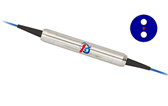
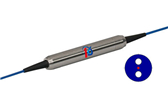
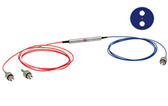
Polarization Maintaining Isolator is also known as Fiber Optic Isolator which allows light to travel only in one direction. For any state of polarization, it minimizes the back reflection and back scattering in the reverse direction. It is a two port micro-optic device built with PM panda fiber. Polarization Maintaining Isolator is used widely in amplifier systems, fiber optic systems, and lasers. It prevents unwanted feedback into an optical oscillator and the device operations are dependent on the Faraday’s effect turn.

Polarization Maintaining Isolator

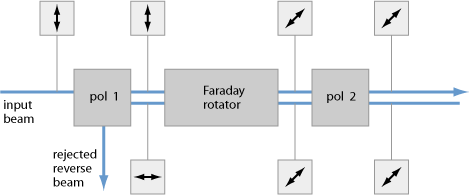
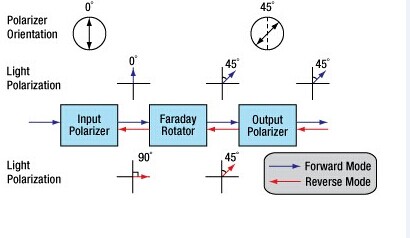
Faraday rotator is the main component of the optical isolator. The polarization dependent isolator mainly consists of 3 parts like an input polarizer, a Faraday rotator, and an output polarizer. The output polarizer is known as the analyser. Input polarizer vertically polarizes the light traveling in the forward direction. Using the analyser, the light traveling in the backward direction becomes polarized by 45°. The polarization dependent isolators are mainly used in free space optical systems as the polarization of source is maintained well by the system.

What are the devices in which the isolator is used?

PM isolator is used in communication systems, polarization maintaining fiber-optic amplifier and instrumentation applications. Also, the insulating system is used in CATV Fiberoptic Links, Fiberoptic System Testing and Fiberoptic LAN System.

Here are the best features of polarization maintaining optical isolator –

  • High Extinction Ratio
  • High Return Loss
  • High Isolator
  • Epoxy Free Optical Ratio
  • Low Insertion Loss

The light traveling in the forward direction is split by the input birefringent wedge into a vertical component which is called ordinary ray and a horizontal component is known as extraordinary ray. The rotator rotates both the o-ray and e-ray by 45°. Again the output birefringent wedge combines the two components. On either sides of the isolator, collimators are used and the beam is split & diverged in the isolated direction.

There are now companies who specialize in the manufacturing of the isolators for various applications. Based on the requirement of applications, isolators are manufactured precisely. Also, one can get the isolators online and the common PM Isolators available online are Polarization Maintaining Isolator 1310 & 1480 & 1550nm and Polarization Maintaining Tap Isolator 1310 & 1550nm.

Work Theory of the Laser Cutting Machine(2)

Cutting methods of laser cutting machine

Vaporization cutting

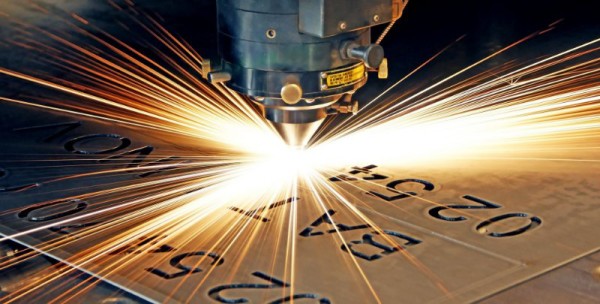
It means that vaporization is the main way to remove the processed material. In the process of vaporization cutting, workpiece surface is heated to vaporization temperature quickly by focused laser beams, forming High pressure steam and spraying outward at supersonic speeds. In the meantime, a hole is formed in the laser active area and laser beams reflex several times in the hole to increase the absorption of laser pump power combiner by material.

When high-pressure vapors spray outward, the melted materials are blown away in the kerf till the workpiece is finally cut. Vaporization cutting needs very high power density, which is eighth power of ten watt above per square centimeter. It is usually applied in low flash point materials and refractory materials.

Reaction Fusion Cutting

Reaction Fusion Cutting

When assistant airflow not only blows the melted materials from the kerf but also has thermal reaction with the workpiece, this is the so-called reaction fusion cutting. Gases that can have reaction with workpiece are oxygen or mixture gases containing oxygen. When the surface  temperature of workpiece reach to ignition temperature, strong combustion heat release occurs to improve the laser cutting ability.

Combustion heat release of low carbon steel and stainless steel is 60%. And it is about 90% for reactive metals like titanium.

Compared to vaporization cutting and general fusion cutting, reaction fusion cutting need less laser power density. However, reaction fusion cutting may effect the performance of worpiece since the combustion reaction can lead to chemical reaction on materials.

Fusion Cutting

When adding a assistant airflow system coaxial with laser to  blow the melted materials away from kerf, this kind of cutting is fusion cutting. In fusion fiber coupler cutting, workpiece needn’t to be heated to vaporization temperature so the required laser power density is reduced greatly.

Laser Scribing

It is mainly used in semiconductor materials, in which laser of high power density make a shallow groove in the semiconductor materials of the workpiece and then makes it crack through mechanistic or vibratory methods. The quality is valued by the surface fragments and size of heat affect area.

Cold Chipping

It is a new processing method, which is put forward along with ultraviolet band superpower excimer laser appeared in recent years. The basic theory is that energy of ultraviolet photons is similar to binding energy of many organic materials; this high-energy photons are used to impact bond organic materials thus make it crack, achieving purpose of cutting. This new technology has promising application future, especially in electron industry.

Thermal Stress Cutting

Mechanism of thermal stress cutting is that laser beams heat an area of fragile material to produce evident temperature gradient. The high surface temperature makes expansion and inner lower temperature hinders expansion, forming pulling stress in the surface and radial crushing stress inside. When the two stresses exceed fracture limit strength of the workpiece, crackle appears. And then the workpiece is broken along the normal direction of the crack. It is suitable for glasses and ceramics.

Conclusion: laser cutting machine is a cutting technology of melting and gasifying surface material through focused energy generated by the use of laser specialties and focused lens. It features good cutting quality, high speed, various cutting material and high efficiency.

About DK Photonics

DK Photonics – www.dkphotonics.com  specializes in designing and manufacturing of high quality optical passive components mainly for fiber laser applications such as 1064nm high power isolator, Cladding Power Stripper, Multimode High Power Isolator, pump combiner,1064nm Band-pass Filter,(6+1)X1 Pump and Signal Combiner, PM Circulator, PM Isolator, optical Coupler. More information, please contact us.


Ultrafast laser pulses induce atoms in gold nanodisks to vibrate

In a study that could open doors for new applications of photonics from molecular sensing to wireless communications, Rice University scientists have discovered a new method to tune the light-induced vibrations of nanoparticles through slight alterations to the surface to which the particles are attached.

In a study published online this week in Nature Communications, researchers at Rice’s Laboratory for Nanophotonics (LANP) used ultrafast laser pulses to induce the atoms in gold nanodisks to vibrate. These vibrational patterns, known as acoustic phonons, have a characteristic frequency that relates directly to the size of the nanoparticle. The researchers found they could fine-tune the acoustic response of the particle by varying the thickness of the material to which the nanodisks were attached.

“Our results point toward a straightforward method for tuning the acoustic phonon frequency of a nanostructure in the gigahertz range by controlling the thickness of its adhesion layer,” said lead researcher Stephan Link, associate professor of chemistry and in electrical and computer engineering.

Rice University researchers (clockwise from front) Man-Nung Su, Wei-Shun Chang and Fangfang Wen discovered a new method to tune the light-induced vibrations of nanoparticles through slight alterations to the surface to which they are attached.

Light has no mass, but each photon that strikes an object imparts a miniscule amount of mechanical motion, thanks to a phenomenon known as radiation pressure. A branch of physics known as optomechanics has developed over the past decade to study and exploit radiation pressure for applications like gravity wave detection and low-temperature generation.

Link and colleagues at LANP specialize in another branch of science called plasmonics that is devoted to the study of light-activated nanostructures. Plasmons are waves of electrons that flow like a fluid across a metallic surface.

When a light pulse of a specific wavelength strikes a metal particle like the puck-shaped gold nanodisks in the LANP experiments, the light energy is converted into plasmons. These plasmons slosh across the surface of the particle with a characteristic frequency, in much the same way that each phonon has a characteristic vibrational frequency.

The study’s first author, Wei-Shun Chang, a postdoctoral researcher in Link’s lab, and graduate students Fangfang Wen and Man-Nung Su conducted a series of experiments that revealed a direct connection between the resonant frequencies of the plasmons and phonons in nanodisks that had been exposed to laser pulses.

“Heating nanostructures with a short light pulse launches acoustic phonons that depend sensitively on the structure’s dimensions,” Link said. “Thanks to advanced lithographic techniques, experimentalists can engineer plasmonic nanostructures with great precision. Based on our results, it appears that plasmonic nanostructures may present an interesting alternative to conventional optomechanical oscillators and high power isolator

Chang said plasmonics experts often rely on substrates when using electron-beam lithography to pattern plasmonic structures. For example, gold nanodisks like those used in the experiments will not stick to glass slides. But if a thin substrate of titanium or chromium is added to the glass, the disks will adhere and stay where they are placed.

“The substrate layer affects the mechanical properties of the nanostructure, but many questions remain as to how it does this,” Chang said. “Our experiments explored how the thickness of the substrate impacted properties like adhesion and phononic frequency.”

Link said the research was a collaborative effort involving research groups at Rice and the University of Melbourne in Victoria, Australia.

“Wei-Shun and Man-Nung from my lab did the ultrafast spectroscopy,” Link said. “Fangfang, who is in Naomi Halas’ group here at Rice, made the nanodisks. John Sader at the University of Melbourne, and his postdoc Debadi Chakraborty calculated the acoustic modes, and Yue Zhang, a Rice graduate student from Peter Nordlander’s group at Rice simulated the optical/plasmonic properties. Bo Shuang of the Landes’ research group at Rice contributed to the analysis of the experimental data.”

The research was supported by the Robert A. Welch Foundation and the Department of Defense’s Multi-University Research Initiative. Additional co-authors include Zhang, Shuang, Nordlander and Halas, all of Rice; and Chakraborty and Sader, both of the University of Melbourne in Victoria, Australia.

About DK Photonics

DK Photonics – www.dkphotonics.com  specializes in designing and manufacturing of high quality optical passive components mainly for fiber laser applications such as 1064nm high power isolator, Cladding Power Stripper, Multimode High Power Isolator, pump combiner,1064nm Band-pass Filter,(6+1)X1 Pump and Signal Combiner, PM Circulator, PM Isolator, optical Coupler. More information, please contact us.

Polarization Dependent Isolator vs Polarization Independent Isolator

Connectors and other types of optical devices on the output of the transmitter may cause reflection, absorption, or scattering of the optical signal. These effects on the light beam may cause light energy to be reflected back at the source and interfere with source operation. In order to reduce the effects of the interference, an optical isolator is usually used. Optical isolator allows a beam of light to stream through a single one way direction. At the same time, it prevents the light from going back in the opposite direction. According to the polarization characteristics, optical isolators can be divided into two types, including polarization dependent isolator and polarization independent isolator. The polarizer-based module makes a polarization dependent isolator, and the birefringent crystal-based structure makes a polarization independent isolator. You may be very confused about them as you find that there is only a little difference via their names. So, what are they and what are the differences between them? This paper will give you the answer.

Polarization Dependent Isolator

The polarization dependent isolator consists of three parts, an input polarizer , a Faraday rotator, and an output polarizer. Light traveling in the forward direction becomes polarized vertically by the input polarizer. The Faraday rotator will rotate the polarization by 45°. The analyser then enables the light to be transmitted through the isolator.

Polarization-Dependent-Isolator

Light traveling in the backward direction becomes polarized at 45° by the analyser. The Faraday rotator will again rotate the polarization by 45°. This means the light is polarized horizontally. Since the polarizer is vertically aligned, the light will be extinguished.

The picture shows us a Faraday rotator with an input polarizer, and an output analyser. For a polarization dependent isolator, the angle between the polarizer and the analyser, is set to 45°. The Faraday rotator is chosen to give a 45° rotation.

Because the polarization of the source is typically maintained by the system, polarization dependent isolator is widely used in free space optical systems.

Polarization Independent Isolator

The polarization independent isolator also consists of three parts, an input birefringent wedge, a Faraday rotator, and an output birefringent wedge. Light traveling in the forward direction is split by the input birefringent wedge into its vertical (0°) and horizontal (90°) components, called the ordinary ray (o-ray) and the extraordinary ray (e-ray) respectively. The Faraday rotator rotates both the o-ray and e-ray by 45°. This means the o-ray is now at 45°, and the e-ray is at −45°. The output birefringent wedge then recombines the two components.

Polarization-Independent-Isolator

Light traveling in the backward direction is separated into the o-ray at 45, and the e-ray at −45° by the birefringent wedge. The Faraday Rotator again rotates both the rays by 45°. Now the o-ray is at 90°, and the e-ray is at 0°. Instead of being focused by the second birefringent wedge, the rays diverge. The picture shows the propagation of light through a polarization independent isolator.

While polarization dependent isolator allows only the light polarized in a specific direction, polarization independent isolator transmit all polarized light. So it is usually widely used in optical fiber amplifier.

Comparison of Polarization Dependent Isolator and Polarization Independent Isolator

In fact, you have already understood these two types of isolators according to the contents above. We can see their similarities and differences through the comparison of their definition, working principle and applications. Both of them consist of three parts and have a same principle based on Faraday effect. However, to overcome the limitation of polarization dependent isolator, polarization independent isolator has been developed. Regardless of the polarization state of the input beam, the beam will propagate through the isolator to the output fiber and the reflected beam will be isolated from the optical source. If the extinction ratio is important, a polarization dependent isolator should be used with either polarization maintaining fibers or even regular single-mode fibers. If the system has no polarization dependence, a polarization independent isolator will be the obvious choice.

About DK Photonics

DK Photonics – www.dkphotonics.com  specializes in designing and manufacturing of high quality optical passive components mainly for fiber laser applications such as 1064nm high power isolator, Cladding Power Stripper, Multimode High Power Isolator, pump combiner,1064nm Band-pass Filter,(6+1)X1 Pump and Signal Combiner, PM Circulator, PM Isolator, optical Coupler. More information, please contact us.

2015-Optical Isolators Global Market Trends

According to ElectroniCast, the worldwide optical isolator consumption reached $584.2 million last year…. 

Aptos, California (USA) – March 2, 2015 — ElectroniCast Consultants, a leading market research & technology forecast consultancy addressing the fiber optics communications industry, today announced the release of a new market forecast of the global consumption of optical isolators in optical communication and specialty applications.

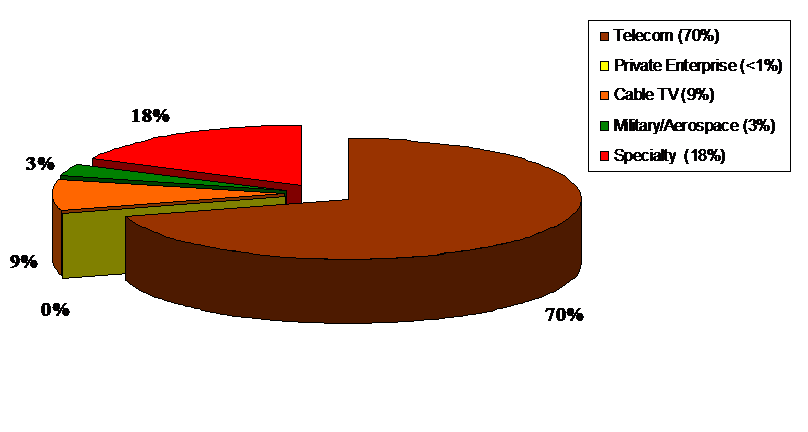
According to ElectroniCast, the worldwide optical isolator consumption reached $584.2 million last year in 2014.  Optical isolator use was led by Telecommunication applications with a 72 percent market share or $419.2 million.  Market data in this study report refers to consumption (use) for a particular calendar year; therefore, this data is not cumulative data.

1064nm-High-Power-Collimated-Free-space-Beam-Output-Isolator

Optical isolators are devices that allow light to be transmitted in only one direction. They are most often used to prevent any light from reflecting back down the optical fiber, as this light would enter the source and cause backscattering and feedback problems. This is especially important for high data rate transceivers and transponders, or those devices requiring long span lengths between transceiver pairs. Optical feedback degrades signal-to-noise ratio and consequently bit-error rate.

1550nm Polarization Isensitive Isolator-300mW

“Continuing demand for upgrading communication networks to accommodate rapidly increasing bandwidth requirements will drive the steady consumption of optical fiber links. Optical isolators are used in with high-speed transmitters that are required to transmit longer distances and/or multiple wavelength transmitters,” stated Stephen Montgomery, Director of the Fiber Optics Components group at ElectroniCast Consultants.

Optical isolators are not widely used in Private Enterprise applications. The worldwide use of fiber optic isolators in Cable TV device deployments are forecast to grow in value at an annual rate of 4.9 percent (2014-2019), as optical fiber is deployed closer to the home driven by multi-media applications.

Optical isolator units are used in a variety of Military/Aerospace applications requiring rigorous testing and harsh environment fiber optic (HEFO) certification to ensure reliability and performance.  Laser-based fiber optic technology incorporating optical isolators are used in a wide variety of air, sea, ground, and space applications.

A major user-group within the Specialty application category is instrument-Laboratory/ R&D.  Optical isolators are used for noise reduction, medical imaging, pulse selection for mode locked lasers, sensing, regeneration switches, disc master, optical trapping, phase shifters, frequency modulation spectroscopy and general shuttering. The optical isolators are also used in sensing for industrial, structures and other many other communication product-oriented manufacturing/test/R&D uses.


DK Photonicswww.dkphotonics.com  specializes in designing and manufacturing of high quality optical passive components mainly for telecommunication, fiber sensor and fiber laser applications,such as 1064nm High Power Isolator,1064nm Components, PM Components, (2+1)x1 Pump Combiner,Pump Laser Protector,Mini-size CWDM,100GHz DWDM,Optical Circulator,PM Circulator,PM Isolator,Fused Coupler,Mini Size Fused WDM.

Optical Isolators Global Market Forecast-DK Photonics

According to ElectroniCast, optical isolator value in Telecommunications is forecast to increase 19.6% this year…

Aptos, California (USA) – April 29, 2014  —ElectroniCast Consultants, a leading market research & technology forecast consultancy addressing the fiber optics communications industry, today announced the release of a new market forecastof the global consumption of optical isolators in optical communication and specialty applications.

According to ElectroniCast, the worldwide optical isolator consumption was led by Telecommunication applications in 2013 with a 70 percent market share or $349.7 million, and is forecasted to increase 19.6 percent in value to $418.2 million this year (2014).  Market forecast data in this study report refers to consumption (use) for a particular calendar year; therefore, this data is not cumulative data.

Optical isolators are devices that allow light to be transmitted in only one direction. They are most often used to prevent any light from reflecting back down the optical fiber, as this light would enter the source and cause backscattering and feedback problems. This is especially important for high data rate transceivers and transponders, or those devices requiring long span lengths between transceiver pairs. Optical feedback degrades signal-to-noise ratio and consequently bit-error rate.

“Continuing demand for upgrading communication networks to accommodate rapidly increasing bandwidth requirements will drive the steady consumption of optical fiber links. Optical isolators are used in with high-speed transmitters that are required to transmit longer distances and/or multiple wavelength transmitters,” stated Stephen Montgomery, Director of the Fiber Optics Components group at ElectroniCast Consultants.

Optical isolators are not widely used in Private Enterprise applications; however, worldwide use of fiber optic isolators in Cable TV controlled device deployments are forecast to grow significantly in value at an annual rate of 8.8 percent (2013-2018), as optical fiber is deployed closer to the home driven by multi-media applications.

Optical isolator units are used in a variety of Military/Aerospace applications requiring rigorous testing and harsh environment fiber optic (HEFO) certification to ensure reliability and performance.  Laser-based fiber optic technology incorporating optical isolators are used in a wide variety of air, sea, ground, and space applications.

A major user-group within the Specialty application category is Laboratory/R&D.  Optical isolators are used for noise reduction, medical imaging, pulse selection for mode locked lasers, sensing, regeneration switches, disc master, optical trapping, phase shifters, frequency modulation spectroscopy and general shuttering. The optical isolators are also used in sensing for industrial, structures and other many other communication product-oriented manufacturing/test/R&D uses.

“During the forecast period (2013-2018), bandwidth expansion demands will push for new network links, incorporating Metro Core, Metro/Access, Long Haul, Optical Fiber Amplifiers, WDM, OADM and other system-based deployments, which incorporate optical isolators,” Montgomery added.

The American region held the lead in terms of relative market share consumption value of optical isolators in 2013, with nearly 43.4 percent; however the American region is forecast to increase at a slower rate compared to the other regions (2013-2018). The Asia Pacific region (APAC) is forecast to increase in worldwide market share from 39.7 percent in 2013 to with 53.7 percent in 2018.  The Europe, Middle East, African region (EMEA) is forecast to remain in the third-place position, however, increase at a faster annual pace versus the American region.

According to ElectroniCast, the American Region leads optical isolator consumption value…

2013 – Optical Isolator Global Value Market Share (%),

By Region, $498 Million

Source: ElectroniCast Consultants

Optical Isolator Global Value Market Share (%)

DK Photonicswww.dkphotonics.com  specializes in designing and manufacturing of high quality optical passive components mainly for telecommunication, fiber sensor and fiber laser applications,such as PLC Splitter, WDM, FWDM, CWDM, DWDM, OADM,Optical Circulator, Isolator, PM Circulator, PM Isolator, Fused Coupler, Fused WDM, Collimator, Optical Switch and Polarization Maintaining Components, Pump Combiner, High power isolator, Patch Cord and all kinds of connectors.

What is Passive Optical Network?

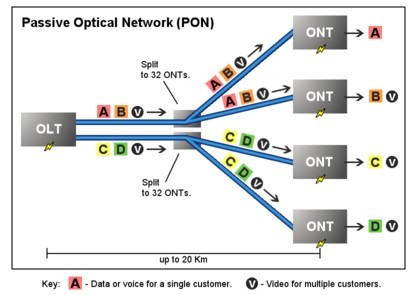
Passive Optical Network (PON) is a form of fiber-optic access network that uses point-to-multipoint fiber to the premises in which unpowered optical splitters are used to enable a single optical fiber to serve multiple premises. A PON system consists of an OLT at the service provider’s central office and a number of ONU units near end users, with an ODN between the OLT and ONU. PON reduces the amount of fiber and central office equipment required compared with point-to-point architectures.

PON Optical Network
Passive Optical Network (PON)

The most obvious advantage of the PON network is the elimination of the outdoor active devices. All the signals processing functions are completed in the switches and the user premises equipment. The upfront investment of this access methods are small, and the most funds investment is postponed until the user really access. Its transmission distance is shorter than the active optical access system. The coverage is also smaller, but it is low cost, no need to set the engine room, and easy to maintain. So this structure can be economically serve for the home users.

PON Development Background

Seen from the entire network structures, due to the larger numbers of laying optical fibers, and widely applications of DWDM technology, the backbone network has been a breakthrough in the development. The same time, due to advances in Ethernet technology, its dominant LAN bandwidth has increased from 10M, 100M to 1G or 10G.. At present, what we are concerned about is the part between the network backbone and local area networks, home users; this is often said that the “last mile”, which a bottleneck is. Must break this bottleneck, may user in the new world of the online world. It is as if in a national highway system, trunk and regional roads have been built in the broad high-grade highway, but leads to the families and businesses of the door was still narrow winding path, the efficiency of the road network cannot play.

What is Optical Circulator? What is the application of Optical Circulator?

What is Optical Circulator?

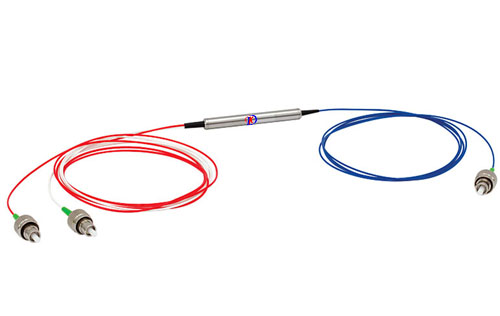
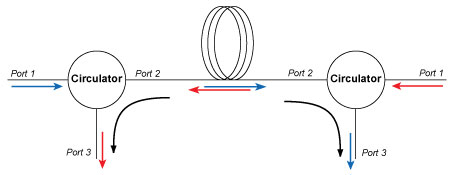
An optical circulator is a special fiber-optic component that can be used to separate optical signals that travel in opposite directions in an optical fiber, analogous to the operation of an electronic circulator. An optical circulator is a three-port device designed such that light entering any port exits from the next. This means that if light enters port 1 it is emitted from port 2, but if some of the emitted light is reflected back to the circulator, it does not come out of port 1, but instead exits from port 3.

3 port Optical Circulator
   3 port Optical Circulator
The application of Optical Circulator

Fiber optic circulators are non-reciprocal optics, which means that changes in the properties of light passing through the device are not reversed when the light passes through in the opposite direction. This can only happen when the symmetry of the system is broken, for example by an external magnetic field. A Faraday rotator is another example of a non-reciprocal optical device.


The Configuration of optical circulator

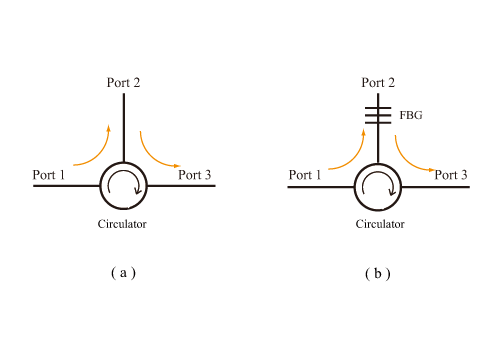
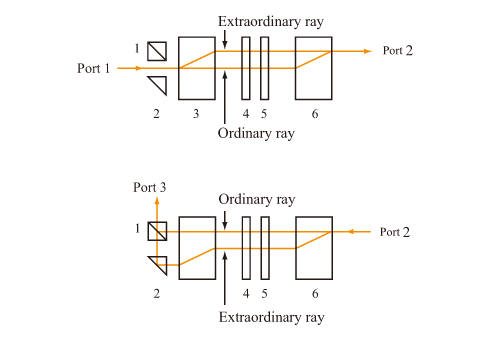
As shown in Fig.2(a), an optical circulator typically has three input or output ports. The signal light input into the port 1 is output from the port 2. The signal light input into the port 2 is output from the port 3. The optical circulator is often used with adding an FBG at the port 2 as shown in Fig.2(b). For reference, a composition of optical circulator is shown in Fig.3.

Optical circulator Schematic of operation and application

Figure 2: Optical circulator. (a) Schematic of operation and (b) application.

Configuration of optical circulator

Figure 3: Configuration of optical circulator. 1: Poparization beam splitter (PBS), 2: reflection prism, 3 and 6: Birefringence crystal, 4: Faraday rotator, 5: half-wave plate


The application of Optical Circulator

An optical circulator is frequently used for an optical time domain reflectometer (OTDR), an optical add-drop multiplexer (OADM) and a dense wavelength devision multiplexing (DWDM) network using an FBG, and a pulse stretcher, a pulse compressor, and a disprersion compensator using a chirped FBG. Optical Circulators can be used to achieve bi-directional transmission over a single fiber. Because of its high isolation of the input and reflected optical powers and its low insertion loss, optical circulators are widely used in advanced communication systems and fiber-optic sensor applications.


Read more related articles :

Optical Circulator

Optical Isolators Global Market Forecast

According to ElectroniCast, the Asia Pacific Region leads in the use of optical isolators…

ElectroniCast Consultants, a leading market research & technology forecast consultancy addressing the fiber optics communications industry, today announced the release of a new market forecast of the global consumption of optical isolators in optical communication and specialty applications.

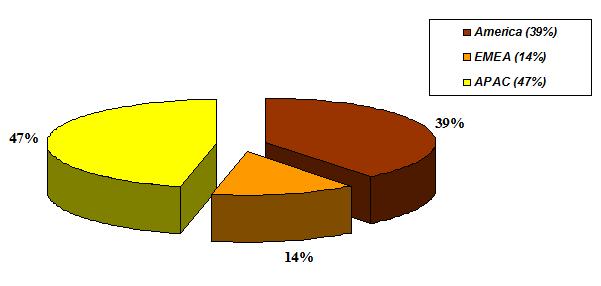
According to ElectroniCast, the Asia Pacific region (APAC), region held the lead in terms of relative market share consumption volume (quantity/number of units) of optical isolators in 2012, with 47 percent; however the Asia Pacific region (APAC), pushed along by the telecommunication category in the People’s Republic of China. The consumption of optical isolators in the APAC region is forecast to nearly triple (3x) during the 2012-2017 time frame.

Optical isolators are passive devices that allow light to be transmitted in only one direction. They are most often used to prevent any light from reflecting back down the optical fiber, as this light would enter the source and cause backscattering and feedback problems. This is especially important for high data rate transceivers and transponders, or those devices requiring long span lengths between transceiver pairs.

Optical isolators are used in many applications in commercial, industrial, and laboratory settings.  They are reliable devices when used in conjunction with fiber optic amplifiers, fiber optic ring lasers, fiber optic links in cable TV/multimedia applications, and high-speed/ DWDM and coherent fiber optic telecommunication communication systems, laboratory R&D, sensors, gyro-systems, test/instrumentation measurement quality assurance applications in automation of manufacturing processes and several others.

ElectroniCast estimates that the Telecommunication applications held 85% of the relative market share of the worldwide consumption volume of optical isolators in 2012.

According to ElectroniCast, 13.4 million optical isolators were used in 2012…

2012 – Optical Isolator Global Volume (Quantity) Market Share (%),

By Region, 13.4 Million Units

optical isolator

DK Photonicswww.dkphotonics.com  specializes in designing and manufacturing of high quality optical passive components mainly for telecommunication, fiber sensor and fiber laser applications,such as PLC Splitter, WDM, FWDM, CWDM, DWDM, OADM,Optical Circulator, Isolator, PM Circulator, PM Isolator, Fused Coupler, Fused WDM, Collimator, Optical Switch and Polarization Maintaining Components, Pump Combiner, High power isolator, Patch Cord and all kinds of connectors.

Application of fiber optic high power isolator and some mutual problems about its production process

1 introduction

Semiconductor lasers, optical amplifiers and optical fiber lasers from the connector, fusion point, filter the reflection light is very sensitive, and may cause performance deterioration and even damaged, requiring a optical isolator to prevent the reflection of light. The optical isolator is permitted only light along one direction through and in the opposite direction blocks light through the optical passive devices. In the optical fiber communication, optical fiber reflection light through the optical isolator can be a good isolation. In the fiber laser applications, optical isolators are usually used in the optical path to avoid the light path of the light source, the echo on the pumping source and other light emitting device causes interference and damage. Isolators’s isolation represents the optical isolator to echo the isolation (blocking) ability.

2 optical isolator principle

Optical isolator using magnetic optical crystal Faraday effect ( also known as the Faraday effect ). In 1845, Faraday first observed with optical material under the action of magnetic field to make the material in the direction of polarization rotation, therefore often called the Faraday effect. In Faraday effect, the rotation of the polarization direction direction and magnetic field, and the orientation of the light transmitting is independent of the forward and reverse, and we usually in the index of refraction, reflection phenomena seen in the reversibility of optical path difference. Along the magnetic field direction of transmission line polarized, the polarization direction rotating angle θand magnetic field strength of B and L is proportional to the product of the length of the material, the proportion coefficient is what we often say that the Wilde constant. Optical isolator based on polarization characteristics can be divided into polarization-independent and polarization dependent type. These two kinds of isolators are used with the Faraday effect in magneto-optic crystal, Faraday magnetic medium in 1~2μ m wavelength range usually adopts the optical loss low yttrium iron garnet ( YIG ) single crystals. Model of input and output of the fiber optical isolator has fairly good performance, the minimum insertion loss of approximately 0.5 dB, the isolation of up to 35~ 60 dB, a maximum of 70 dB.   The optical isolator using most still is polarization independent type, its principle is shown in Figure 1, using the forward and reverse transmission optical path is inconsistent, it is this time signal transmission is not reversible, thereby forming isolation. The typical structure of only four major components: the magnetic ring, a Faraday rotator, two pieces of LiNbO3 wedge angle piece, with a pair of fiber collimator, can be made into an in-line optical isolators.

Positive transmission: the parallel light beam from the collimator, into the first wedge angle piece P1, beam is divided into o light and e light, the polarization direction perpendicular to the propagation direction, forming an included angle. When they pass through 45o Faraday rotator, emitted by the o light and e light polarizing surfaces of respective to the same direction of rotation 45o, because the second wedge-shaped plate P2 crystal axis relative to the first wedge angle piece is just in a 45o angle, so o light and e light is refracted into a small space, synthesis. Parallel light, and then by another collimator is coupled to the optical fiber core. In this case, the input optical power only a very small fraction of outage, this loss is called isolator insertion loss.

Reverse transmission: when a beam of parallel light reverse transmission, first with a P2 crystal, divided into the polarization direction and P1 crystal axis respectively in 45o angle o light and E light. Due to the Faraday effect non reciprocity, O Light and e light through the Faraday rotator, the polarization direction to the same direction of rotation 45 °, so the original o light and e light in the second wedge-shaped plate ( P1 ) later became e and O light. Because the refractive index differences, the two light beam in the P1 no longer possible synthesis of a parallel beam of light, but in different directions to the refraction of light, e and o are further separated from a larger perspective, even after a GRIN lens coupling, can not enter the fiber core to, from and achieved reverse isolation purposes. The transmission loss is bigger, this loss is called isolators isolation.

3 main technical parameters of optical isolator

The optical isolator, the main technical indicators have insertion loss, reverse isolation, return loss, polarization dependent loss, polarization mode dispersion.

(1) insertion loss ( Insertion Loss ): isolator core mainly comprises a Faraday rotator and a two piece of LN wedge angle piece, a Faraday rotator extinction ratio higher, lower reflectivity, absorption coefficient is smaller, insertion loss is smaller, general Faraday rotator loss is about 0.02~ 0.06dB. Parallel light pass through the isolator core, will be divided into o, e beams of parallel light. Due to the inherent characteristics of birefringent crystals, O Light and e light can not fully converge, which may cause additional insertion loss.

(2) reverse isolation ( Isolation ): reverse isolation isolator is one of the most important indicators, which characterizes the isolator on the reverse transmission attenuation ability. Effect of isolator isolation of many factors : 1 ) the isolation and polarizer from the Faraday rotator is related to the distance; 2) isolation and optical element surface reflectance relationship. Isolator optical element surface reflectance is bigger, the isolation degree is worse. The practical technology that R must be less than 0.25%, to ensure the isolation degree is greater than 40 dB; 3) isolation of polarimeter and wedge angle, spacing. Double refraction crystal yttrium vanadate ( YVO4 ) of the optical isolator, when the wedge angle of less than 2°, isolation with the perspective of the increase, when the wedge angle is greater than 2°, change is much smaller, approximately stable at about 43.8 dB. Optical isolation with the increase of the distance between the change range is not big, because isolation depends mainly on the reverse output light and the angle between the optical axis; 4) isolation and crystal axis angular relationship relative. The two polarizers and rotator crystal axis relative angle to the isolation effect is maximum, when the angle is greater than the difference between the 0.3o isolation will not be greater than 40 dB; 5) the two polarizer extinction ratio, crystal thickness on isolation effect; 6) the influence of temperature and magnet. In Faraday effect, Verdet constant is a function of temperature, so the Faraday rotation angle will change with the temperature, and the temperature will be on permanent magnet performance impact, so it is one of important factors.

(3) return loss ( Return Loss ): optical return loss refers to the positive incident to the isolator optical power and along the input path to return to the isolator input port of the optical power ratio, this is one of the important indicators, because the echo intensity, isolation would be affected by. Isolator echo loss by each element and the air refractive index mismatch caused by the reflection. The generally planar element caused by echo return loss is controlled in 14 dB, through antireflective film and surface polishing can make the return loss reached more than 60 dB. Optical return loss mainly from the collimated light path (i.e., collimator parts), through the theoretical calculation when the slant angle 8 °, return loss is greater than 65 dB.

(4) the polarization-dependent loss ( Polarization Dependent Loss, PDL ) :PDL and insertion loss is different, it is a when the input light polarization state changes and other parameters unchanged, the insertion loss of maximum variation, is a measure of device insertion loss by effect of polarization degree index. The polarization-independent optical isolator, the device has some may cause polarization components, impossible to achieve PDL is zero, a generally accepted PDL is less than 0.2 dB.

(5) the polarization mode dispersion ( Polarization Mode Dispersion, PMD ) :PMD is defined through the device of the signal light with different polarization states of the phase delay between, in high speed optical communication system is very important in PMD. In optical passive devices, different polarization modes have different propagation paths and different propagation speed, produce corresponding polarization mode dispersion. At the same time, because the light source spectrum lines have a certain bandwidth, can also cause certain dispersion. In a polarization-independent optical isolator, birefringent crystal to produce two beams linearly polarized light in different phase velocity and group velocity of transmission, which is PMD, its main source is used for separation and convergence o light and e light of birefringent crystal. It can be made of two linearly polarized optical path differenceΔ L approximation. PMD is mainly affected by E and O optical refractive index difference, therefore also has great relationship with wavelength.

4 key technologies of high power isolator

Compared with the common optical fiber communication system in the use of low power optical isolator is compared, in the high power laser, optical isolator design and production also exhibit differences, it is also in high power device is designed to solve the main problems in the development of.

(1) the optical element at a high power density laser radiation damage problems. Not only is this problem in a high power optical isolator in existence, is the other high power optical device design process is also to face. In order to solve this problem, first of all need to products in the production and testing process to ensure good environmental cleanliness and selects the damage threshold of high optical device and optical thin films, of course it is cost constraint. Because the air in the tiny particles if adhesion in optical surface will greatly reduce the laser damage threshold of optical surface, these tiny particles on laser absorption is relatively large, easily lead to particle near the energy is concentrated, resulting in optical surface film damage even surface damage, the element surface pitting and even small pit to device failure. Secondly, because in most cases within the optical element damage threshold than the surface laser damage threshold is much higher, so the surface of the laser power density is determined by the whole device resisting laser damage ability, especially in the pulse work situation is even more so. This can be through optical transform method to make optical element surface spot area expansion method to increase the damage threshold, such as expanded core fiber and beam expanding lens optical method is the use of the principle of work, or by changing the laser pulse stretching method to reduce the power density of laser, laser energy in space and by avoiding time of concentration can effectively improve product for resisting laser damage properties.

(2) the high power device for thermal effects and thermal design. Because of the high power device to work in a higher power, and low power devices compared, easy fever, inevitably subjected to temperature rise, so the device performance by the thermal characteristics and thermal design to compare the effects of severe. Usually the optically active crystal optical rotation characteristic of easily affected by temperature, if the device is operating due to the absorption of laser energy accumulation and lead to internal temperature appears bigger rise, will make the optically active crystal on light polarization plane rotation angle deviations from normal values and lead to significant performance loss, serious and even lead to damaged devices; in addition, the permanent magnet at work under high temperature but also more prone to field weakening and demagnetization phenomenon, appear even the magnetic field of the irreversible loss, so the high temperature to the permanent magnet steady work is negative; and, in case of high optical power, optical element temperature will appear bigger rise, due to heat from the inside to the conveying surface, its internal the temperature is above its surface temperature, so that it will in the optical component internal temperature gradient and thermal stress, causing the beam cross-sectional internal center of the refractive index and the edge of the refractive index change in different extent, appear thereby the refractive index difference, also is the emergence of lens effect, it will change the beam propagation characteristics, leading to beam quality drops badly, seriously affect the normal work and even cause damage to device. Therefore, we must take effective measures to reduce the absorption of laser radiation and effective. To reduce the absorption of laser selected absorption coefficient smaller optical materials, Ko Hikaru in the components inside the transmission distance, reasonable structure design, effective heat dissipation requirements may arise in heat accumulation place provides effective heat transfer path and heat dissipation, according to the size of power can adopt a passive or active heat radiation method. The million kilowatts level optical isolation design on the use of the lath shape of the optically active crystal to improve device cooling temperature control ability.

(3) the magnetic field design for high power isolator. High power optical isolator design another key is the magnetic field and magnet design and selection. In general, the optical isolator is the use of magnetic rotation effect work, so must the optically active crystal with proper magnetic field. In order to energy saving and convenient use, generally by the strong permanent magnetic material to produce a desired magnetic field, the magnetic field and magnet selection and design is very important, on device performance and the cost of. Under normal circumstances required in the optically active crystal space to provide a strong homogeneous magnetic field, so it can reduce the optically active crystal size, high ratio of performance to price, so the requirement in without significantly increasing the device volume in the case of the design of suitable magnet to obtain a strong homogeneous magnetic field. In specific design, through the choice of magnetic strong magnets, and adopt suitable shape and volume, to obtain the required magnetic field

(4) High power optical isolator assembly process. High power optical isolator can work stably for a long time in bad environment, this device structure and assembly process raised very tall requirement. Design of the structure and assembly technology can effectively reduce the optical components of the internal stress, thereby improving the product performance and stability, allows the device to long-term stable and reliable work. Isolator structure design mainly need to solve two problems, first is the optical components of the assembly, stable and reliable heat dissipation requirements, can effectively control; second is firm and reliable assembly of strong permanent magnet, with the magnet design and manufacturing capabilities, devices may use more complex shape of the magnet pieces combined to provide a strong homogeneous magnetic field, between the magnets and strong magnetic requires the design of suitable assembly method and reliable assembly magnet, and required in the assembly process causes no damage or the magnet demagnetization. These need to be accumulated in practice and improve.

Above only briefly in the high power optical isolator design process often encounter some problems, along with applications to expand and deepen, may be needed for isolator corresponding improvement or design to meet the technical and market development, in this process may occur early in the design of possibly unforeseen problems, this requires us to according to the specific circumstances to provide the corresponding solutions, only in this way can we continue to design excellent performance to meet the application needs of the high power optical isolator.