Optical fibers with relatively large mode areas and a single transverse mode or only a few modes.
For some applications, it is desirable to use optical fibers with a large mode area (LMA fibers) – often with single-mode guidance. Due to the reduced optical intensities, such fibers effectively have lower nonlinearities and a higher damage threshold, which makes them suitable for example for the Amplification of intense Pulses or single-frequency signals in Fiber amplifiers, or in case of passive fibers for delivery of such light. While standard single-mode fibers have an Effective Mode Area below 100 μm2, large mode area fibers reach values of hundreds or even thousands of μm2.
DK Photonics – www.dkphotonics.com specializes in designing and manufacturing of high quality optical passive components mainly for fiber laser applications such as 1064nm high power isolator, Cladding Power Stripper, Multimode High Power Isolator, pump combiner,1064nm Band-pass Filter,(6+1)X1 Pump and Signal Combiner, PM Circulator, PM Isolator, optical Coupler. More information, please contact us.
The 2015 Ringier Technology Innovation Awards – Laser Industry is now open for applications up until January 4, 2015.
Now in its second year, the Awards consist of six categories: Lasers, Laser Systems for Production Engineering (Laser Cutting Systems, Laser Engraving Systems, Laser Marking Systems, and Laser Welding Systems), Laser System Components, System Peripherals of Laser Production Engineering, Optical Materials and Components, and 3D Printing. Only new products and solutions launched during 2013-2015 in the China market are eligible to enter the Awards selection process.
Following the entry and nomination stage, online peer voting and expert judging will take place January 9-25, 2015. Industry experts, including Dichen Li, Ph.D., Changjiang Professor, Xi’an Jiaotong University; Xiahui Tang, Professor, National Engineering Research Center For Laser Processing; Youliang Wang, Chairman, Laser Processing Committee of China Optical Society; Xiao Zhu, Chairman, Wuhan Laser Association of Optics Valley of China; and Qingmao Zhang, Vice Chairman, Laser Processing Committee of China Optical Society, will be among the independent panel of judges. Winners will be announced at the Awards ceremony on March 18, 2015, to coincide with Laser World of PHOTONICS 2015 in Shanghai, when all the winners, judges, industry professionals, and media will be present.
Organized by Industrial Laser Solutions China, Ringier Trade Media, and supported by Industrial Laser Solutions, these Awards are presented to a select group of innovators each year in China. The purpose of the Awards is to encourage, acknowledge, and reward those individuals and companies who have introduced and developed a new idea, a new methodology, a new product or a new technology for manufacturing production efficiency, cost-effectiveness, and user convenience, which might result in energy saving and more responsible clean manufacturing in the laser industry.
The Ringier Technology Industry Awards Series have been established since 2006 and cover nine different industries. They are recognized as being the most honest, transparent, and fairest of such Industry Awards in China. Nominations are open to all and the final selections are made by the panel of independent judges based solely on merit.
DK Photonics – www.dkphotonics.com specializes in designing and manufacturing of high quality optical passive components mainly for fiber laser applications such as 1064nm high power isolator, Cladding Power Stripper, Multimode High Power Isolator, pump combiner,1064nm Band-pass Filter,(6+1)X1 Pump and Signal Combiner, PM Circulator, PM Isolator, optical Coupler. More information, please contact us.
CASERTA, Italy, Sept. 29, 2014 — Fiber optic sensors could warn people of imminent landslides, potentially saving lives and reducing destruction.
A team at the Second University of Naples is developing sensor technology that could detect and monitor both large landslides and slow slope movements. The researchers hope to mitigate the effects of these major natural disasters, similar to the way hurricane tracking can prompt coastal evacuations.
Optical fiber sensors embedded in shallow trenches within slopes would detect small shifts in the soil, the researchers said. Landslides are always preceded by various types of pre-failure strains, they said.
While the magnitude of pre-failure strains depends on the rock or soil involved — ranging from fractured rock debris and pyroclastic flows to fine-grained soils — they are measurable. Electrical sensors have long been used for monitoring landslides, but that type of sensor can be easily damaged, the researchers said. Optical fiber is more robust, economical and sensitive.
“Distributed optical fiber sensors can act as a ‘nervous system’ of slopes by measuring the tensile strain of the soil they’re embedded within,” said professor Dr. Luigi Zeni.
The researchers are also combining several types of optical fiber sensors into a plastic tube that twists and moves under the forces of the pre-failure strains. This will allow them to monitor the movement and bending of the optical fiber remotely to determine if a landslide is imminent.
The use of fiber optic sensors “allows us to overcome some limitations of traditional inclinometers, because fiber-based ones have no moving parts and can withstand larger soil deformations,” Zeni said.
He added that such sensors can be used to cover several square kilometers and monitored continuously to pinpoint critical zones.
The team will present their research at Frontiers in Optics in Tucson, Ariz., next month.
DK Photonics – www.dkphotonics.com specializes in designing and manufacturing of high quality optical passive components mainly for telecommunication, fiber sensor and fiber laser applications,such as PLC Splitter, WDM, FWDM, CWDM, DWDM, OADM,Optical Circulator, Isolator, PM Circulator, PM Isolator, Fused Coupler, Fused WDM, Collimator, Optical Switch and Polarization Maintaining Components, Pump Combiner, High power isolator, Patch Cord and all kinds of connectors.
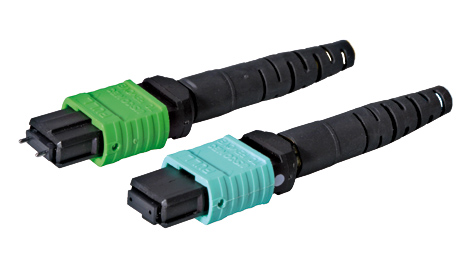
MPO fiber optic connectors used in North American 40/100GbE communication links are forecast to increase at a rate of 49.8% per year through 2018…
Aptos, CA (USA) – August 20, 2014 —ElectroniCast Consultants, a leading market & technology forecast consultancy addressing the fiber optics communications industry, today announced the release of their market forecast and analysis of the use of MPO fiber optic connectors in 40 gigabit Ethernet (GbE) and 100GbE Standard communication network links. MPO is the industry acronym for “multi-fiber push on.”
“Applications such as video, virtualization, cloud computing, switching/routing and convergence are driving the need for bandwidth expansion in data centers, 4G/LTE (wireless) networks, and other deployments. We continue on the path of gradually migrating from 1G to 10G to 40G and 100G and eventually beyond; and the MPO connector is a key component in 40/100GbE network links, ” said Stephen Montgomery, director of the fiber optics components group at ElectroniCast.
The use of MPO fiber optic connectors in North American 40GbE and 100GbE networks is expected to reach $28 million in 2014, an increase of 84% over last year (2013). The use of 40/100GbE MPO connectors in North American is forecast to increase at annual rate of 49.8% per year over the 2013-20189 timeframe covered in the ElectroniCast market forecast. Market forecast data in the market study refers to consumption (use) for a particular calendar year; therefore, this data is not cumulative data.
The market forecast is segment by the use of single-mode and multimode 12-fiber and 24-fiber MPO connectors, and further broken-out by the use of connectors in 40G and the connectors used in 100G.
According to the market study, the North American 40/100GbE MPO connector market expansion will be dominated by the 12-fiber multimode MPO connectors, increasing at an average annual growth rate of 48.5 percent during the forecast period.
DK Photonics – www.dkphotonics.com specializes in designing and manufacturing of high quality optical passive components mainly for telecommunication, fiber sensor and fiber laser applications,such as PLC Splitter, WDM, FWDM, CWDM, DWDM, OADM,Optical Circulator, Isolator, PM Circulator, PM Isolator, Fused Coupler, Fused WDM, Collimator, Optical Switch and Polarization Maintaining Components, Pump Combiner, High power isolator, Patch Cord and all kinds of connectors.
Huawei says it has collaborated with Russian service provider Rostelecom to develop floor distribution boxes (FDBs) for use in Rostelecom’s flexible fiber to the home (FTTH) deployments. The FDBs will help improve the efficiency of the operator’s FTTH deployments, particularly in sparsely populated areas, Huawei says.
Rostelecom is under a mandate from the Russian government to connect 13 million CWDM Module users by 2015, Huawei says. This task is complicated by the fact that much of the operator’s footprint covers rural areas.
To improve deployment efficiency, Huawei says it recommended what it calls “the thin-covered network deployment model.” According to the model, fiber-optic networks are constructed to user access points and the FDBs, the latter of which are used as the interface between the outside plant and the inside plant. As the network expands and more users are connected, pre-made drop cables can be used for plug-and-play, quick service provisioning.
The customized FDBs were designed for success-based deployment. Rostelecom can deploy FDBs that provide access to a single user, then add connections as many as four or eight users as take rates improve. Technicians can complete the expansion in one minute without the use of tools, Huawei says.
Huawei and Rostelecom will further collaborate on other network elements, including the closure, optical splitter, and fiber distribution terminal (FDT), the technology provider added.
For more information on FTTx products, visit the DK Photonics Website.
DK Photonics – www.dkphotonics.com specializes in designing and manufacturing of high quality optical passive components mainly for telecommunication, fiber sensor and fiber laser applications,such as PLC Splitter, WDM, FWDM, CWDM, DWDM, OADM,Optical Circulator, Isolator, PM Circulator, PM Isolator, Fused Coupler, Fused WDM, Collimator, Optical Switch and Polarization Maintaining Components, Pump Combiner, High power isolator, Patch Cord and all kinds of connectors.
According to ElectroniCast, optical isolator value in Telecommunications is forecast to increase 19.6% this year…
Aptos, California (USA) – April 29, 2014 —ElectroniCast Consultants, a leading market research & technology forecast consultancy addressing the fiber optics communications industry, today announced the release of a new market forecastof the global consumption of optical isolators in optical communication and specialty applications.
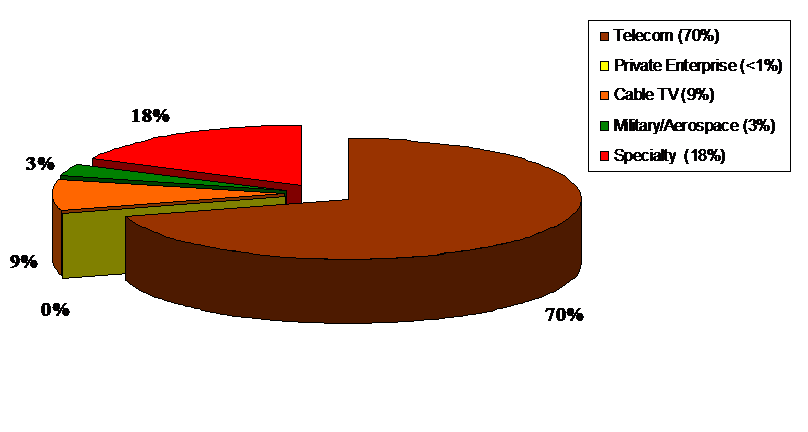
According to ElectroniCast, the worldwide optical isolator consumption was led by Telecommunication applications in 2013 with a 70 percent market share or $349.7 million, and is forecasted to increase 19.6 percent in value to $418.2 million this year (2014). Market forecast data in this study report refers to consumption (use) for a particular calendar year; therefore, this data is not cumulative data.
Optical isolators are devices that allow light to be transmitted in only one direction. They are most often used to prevent any light from reflecting back down the optical fiber, as this light would enter the source and cause backscattering and feedback problems. This is especially important for high data rate transceivers and transponders, or those devices requiring long span lengths between transceiver pairs. Optical feedback degrades signal-to-noise ratio and consequently bit-error rate.
“Continuing demand for upgrading communication networks to accommodate rapidly increasing bandwidth requirements will drive the steady consumption of optical fiber links. Optical isolators are used in with high-speed transmitters that are required to transmit longer distances and/or multiple wavelength transmitters,” stated Stephen Montgomery, Director of the Fiber Optics Components group at ElectroniCast Consultants.
Optical isolators are not widely used in Private Enterprise applications; however, worldwide use of fiber optic isolators in Cable TV controlled device deployments are forecast to grow significantly in value at an annual rate of 8.8 percent (2013-2018), as optical fiber is deployed closer to the home driven by multi-media applications.
Optical isolator units are used in a variety of Military/Aerospace applications requiring rigorous testing and harsh environment fiber optic (HEFO) certification to ensure reliability and performance. Laser-based fiber optic technology incorporating optical isolators are used in a wide variety of air, sea, ground, and space applications.
A major user-group within the Specialty application category is Laboratory/R&D. Optical isolators are used for noise reduction, medical imaging, pulse selection for mode locked lasers, sensing, regeneration switches, disc master, optical trapping, phase shifters, frequency modulation spectroscopy and general shuttering. The optical isolators are also used in sensing for industrial, structures and other many other communication product-oriented manufacturing/test/R&D uses.
“During the forecast period (2013-2018), bandwidth expansion demands will push for new network links, incorporating Metro Core, Metro/Access, Long Haul, Optical Fiber Amplifiers, WDM, OADM and other system-based deployments, which incorporate optical isolators,” Montgomery added.
The American region held the lead in terms of relative market share consumption value of optical isolators in 2013, with nearly 43.4 percent; however the American region is forecast to increase at a slower rate compared to the other regions (2013-2018). The Asia Pacific region (APAC) is forecast to increase in worldwide market share from 39.7 percent in 2013 to with 53.7 percent in 2018. The Europe, Middle East, African region (EMEA) is forecast to remain in the third-place position, however, increase at a faster annual pace versus the American region.
According to ElectroniCast, the American Region leads optical isolator consumption value…
2013 – Optical Isolator Global Value Market Share (%),
By Region, $498 Million
Source: ElectroniCast Consultants
Optical Isolator Global Value Market Share (%)
DK Photonics – www.dkphotonics.com specializes in designing and manufacturing of high quality optical passive components mainly for telecommunication, fiber sensor and fiber laser applications,such as PLC Splitter, WDM, FWDM, CWDM, DWDM, OADM,Optical Circulator, Isolator, PM Circulator, PM Isolator, Fused Coupler, Fused WDM, Collimator, Optical Switch and Polarization Maintaining Components, Pump Combiner, High power isolator, Patch Cord and all kinds of connectors.
A fiber-optic multiplexer is a device that processes two or more light signals through a single optical fiber, in order to increase the amount of information that can be carried through a network. Light wavelengths are narrow beams that ricochet through reflective optical tubing, sometimes over long distances, to provide instantaneous electronic signal processing at the speed of light. Multiplexers work by increasing a fiber’s transmission capacity using different techniques and light source technologies. When the signal arrives at its destination, a demultiplexer separates the data streams. Using a multiplexer also allows data to be sent farther, more securely, and with less electromagnetic and radio frequency interference.
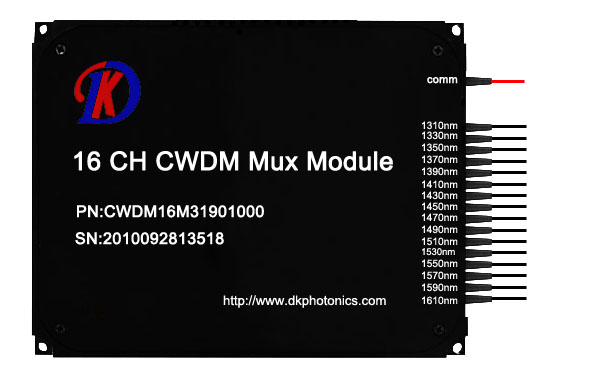
16CH CWDM
Also known as a mux, the fiber-optic multiplexer saves time and cost by squeezing more information through the optical network pathway. It is possible to split signals by varying the schedule or period of each transmission. Time Division Multiplexing (TDM) combines multiple signals by rapidly alternating between them so that only one is transmitting at any given time. Statistical Time Division Multiplexing (STDM) assigns each signal a specific time slot in order to optimize bandwidth usage. Further techniques include divisions of wavelength and frequency.
Wavelength Division Multiplexing (WDM) utilizes the total available pass band of an optical fiber. It assigns individual information streams different wavelengths, or portions of the electromagnetic spectrum. Similarly, Frequency Division Multiplexing (FDM) assigns each signal a different frequency. Carrier frequencies contain the signal while unused guard frequencies provide buffering to reduce interference. This helps minimize audible and visual noise and preserves the integrity of the original signal throughout the network.
Fiber-optic multiplexer technology serves single-mode and multimode optical fibers with multichannel rack mount or standalone units. This makes mixing channels with different configurations possible for a range of interface combinations. These devices provide stronger, more reliable transmissions in areas that have a lot of electromagnetic, radio frequency, or lightning interference.
As technology improves and information needs grow to fill the capacities of existing networks, equipment such as the fiber-optic multiplexer lessens the need to upgrade the fiber-optic infrastructure itself. Multiplexers permit new configurations of transmission protocols by increasing the amount of wavelengths or frequencies of light signals. By upgrading repeaters and terminal equipment, existing network transmission capacity can expand with demand.
Used by cellular carriers, Internet service providers, public utilities, and businesses, fiber-optic multiplexer technology extends the reach and power of telecommunications technologies. Network management systems allow for system service and maintenance, and provide for security, fault management, and system configuration. With advantages like lower costs and longer life expectancies, current fiber-optical networks are aided by improvements in multiplexing technology, and may provide light speed data transmission well into the future.
DK Photonics – www.dkphotonics.com specializes in designing and manufacturing of high quality optical passive components mainly for telecommunication, fiber sensor and fiber laser applications,such as PLC Splitter, WDM, FWDM, CWDM, DWDM, OADM,Optical Circulator, Isolator, PM Circulator, PM Isolator, Fused Coupler, Fused WDM, Collimator, Optical Switch and Polarization Maintaining Components, Pump Combiner, High power isolator, Patch Cord and all kinds of connectors.
Fiber Media Converters in Private DatacomMarket Forecast (March 2014)
According to ElectroniCast, the global use of fiber media converters in private datacom networks is expected to reach $1.29 billion in 2014…
Aptos, CA (USA) – March 20, 2014 —ElectroniCast Consultants, a leader in fiber optic market research, announced the release of a new market analysis of the worldwide use of fiber optic / Fiber media converters in private data communications. A fiber media converter is a networking device that makes it possible to connect two dissimilar media types such as copper with fiber optic cabling, as well as (different) fiber-to-fiber (F2F), such as multimode to single mode optical fiber.
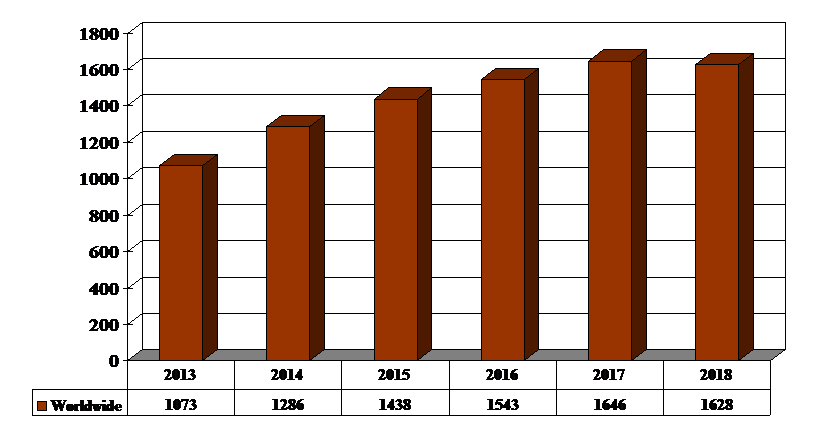
The worldwide value for selected fiber media converters used in private datacom networks reached $1.07 billion in 2013. The consumption value is forecast increase with strongly rising quantity growth partially offset by declining average prices.
The EMEA and the APAC regions are forecast for double-digit consumption value growth during the timeline covered in this study (2013-2018); however, the American region’s growth is forecast to “flatten” and eventually turn to negative. The worldwide use of private datacom fiber media converters, which are specified in the ElectroniCast market study, is forecast to peak at $1.646 billion in 2017, before slipping to $1.628 billion in 2018.
“The fiber media converters researched in this market study are typically used within an existing Private Enterprise Data Centers (DCs) and Local Area Networks (LANs), as well as other non-public data communication links. They are often used to connect newer 100-Mbps, Gigabit Ethernet, 10G, or other equipment in existing networks, which are generally (copper-based) 10BASE-T, 100BASE-T, or a mixture of both,” stated Stephen Montgomery, Director of the Fiber Optics Components group at ElectroniCast Consultants.
“Several factors make the conversion from copper to optical fiber a good choice, such as – longer link lengths in campuses and industrial plants; resistance to electromagnetic and radio-frequency interference (EMI/RFI) may be necessary; and wider bandwidth capability, just to point-out a few examples,” Montgomery added.
The strong user demand for greater bandwidth and increased interconnectivity to the desktop, throughout the buildings, campuses, from LAN-to-LAN (Metropolitan Area Network – MAN) continues in 2014.
This is matched by rapidly growing demand for global broadband interconnectivity. Interactive multimedia terminals, triple play (voice, video and data), quadruple-play (adding mobility as a communications function to the network), and numerous other dynamics/ applications, continuing bring rapid access to massive databases, which increase productivity while providing rapid ROI (return on investment).
Such expanded capability, however, must often be obtained without making the current network elements obsolete. Local area network (LAN) applications illustrate this trend. LANs are becoming larger and more complex. Reconfiguration, relocation, and extension of LANs are occurring more frequently, due to organization restructuring, advances in computer usage, and the trend toward decentralized computing.
These changes to LAN cabling represent a major ongoing operational expense and a disruption of work for many companies (enterprises). For example, adding capabilities often requires that network administrators upgrade their existing LANs to another media type: for example, copper-to-fiber, multimode-to-singlemode fiber, or even singlemode –to- different types of singlemode optical fiber (note: copper-to-copper conversion is not covered in the study). By using media converters, the network administrator can achieve these upgrades inexpensively.
According to ElectroniCast, the global use of fiber media converters in private datacom reached $1.07 billion in 2013 and is forecast to peak at $1.646 billion in 2017, before slipping to $1.628 billion in 2018.
Private Datacom Fiber Media Converter Global Market Forecast,
(Value Basis, $ Million) – Source: ElectroniCast Consultants
Private Datacom Fiber Media Converter Global Market Forecast,
Note: Market forecast data in this study report refers to consumption (use) for a particular calendar year; therefore, this data is not cumulative data.
DK Photonics – www.dkphotonics.com specializes in designing and manufacturing of high quality optical passive components mainly for telecommunication, fiber sensor and fiber laser applications,such as PLC Splitter, WDM, FWDM, CWDM, DWDM, OADM,Optical Circulator, Isolator, PM Circulator, PM Isolator, Fused Coupler, Fused WDM, Collimator, Optical Switch and Polarization Maintaining Components, Pump Combiner, High power isolator, Patch Cord and all kinds of connectors.
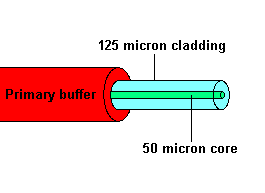
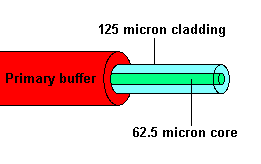
We have created this page to illustrate the very basic differences between 62.5 and 50/125 multimode fiber in selecting a patch cable for your existing cable plant.
62.5/125 um Vs. 50/125um Multimode fiber
62.5/125 um Vs. 50/125um Multimode fiber
The key thing to remember is to always use a patch cable of the same type as the cable that you are connecting to. It is virtually impossible to tell the difference between the two fiber types (62.5 and 50/125) by looking at the bare fiber* or the connectors*. Usually, this information will be written on the cable’s jacket.
The photos above illustrate that the outer diameters of the two fiber types are the same. What is different is the size of the center light carrying core of the fiber. You cannot see the fiber’s core without a microscope*. Therefore, you must rely on the writing that is on the fibers jacket to determine what type is.
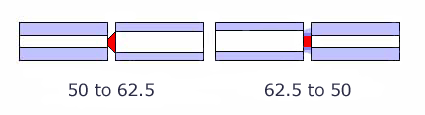
Severe losses of light can occur when you try to match 50/125 and 62.5/125 fiber, as the illustration on the left shows.
* CAUTION: Never look directly into a fiber cable’s end face or into the ferrule of a connector (with fiber present) as there may be dangerous laser light present.
NOTE: This page was designed to help you know the difference between 62.5 and 50/125 fiber for the purpose of purchasing patch cables and products to connect to existing installed cabling. This page was not designed to provide information on choosing between the two types fiber for new installations.