
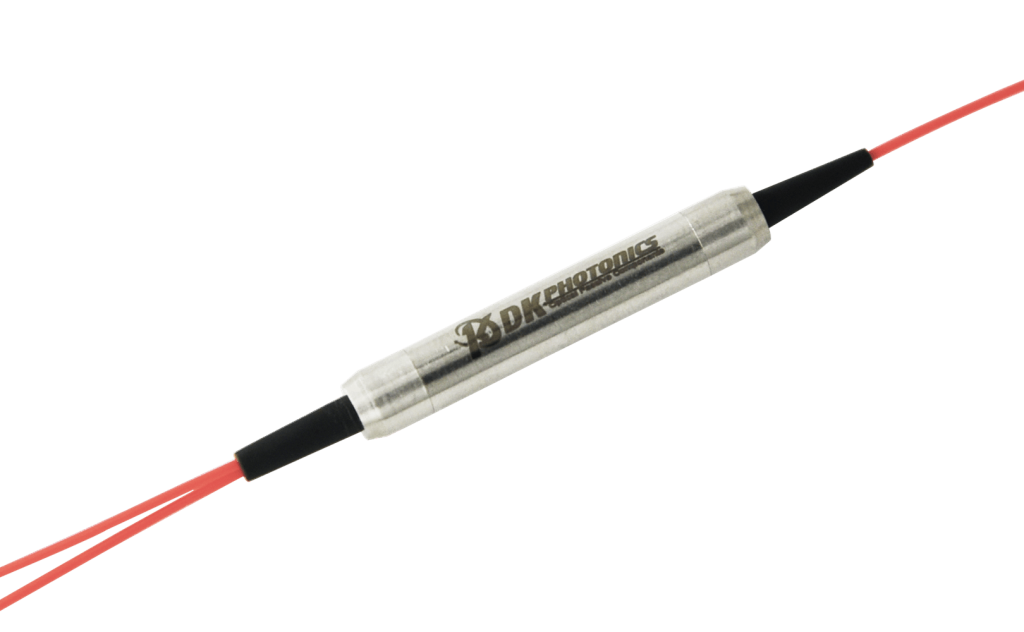
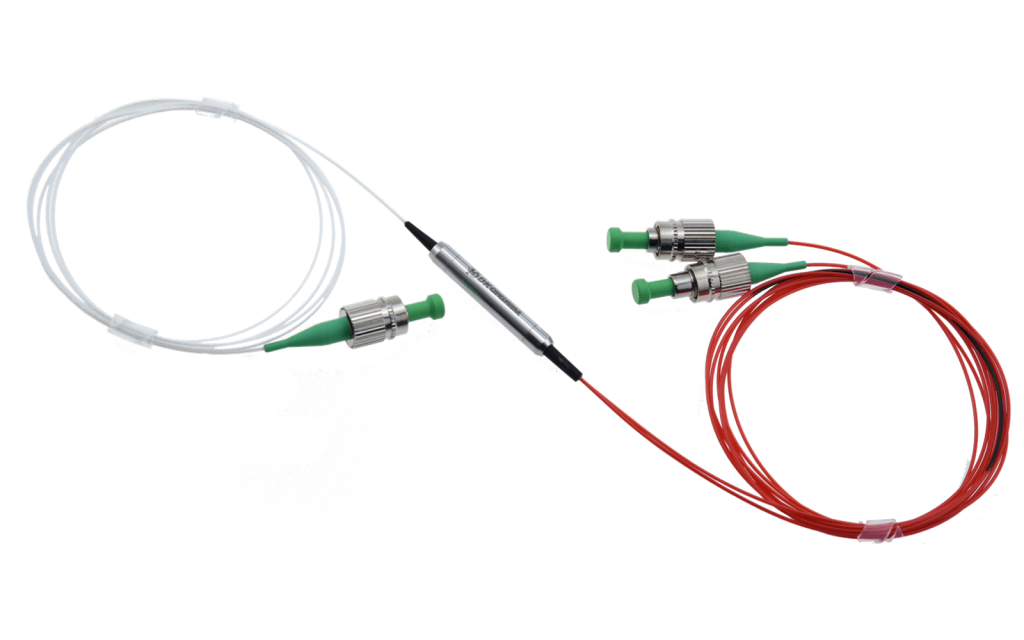
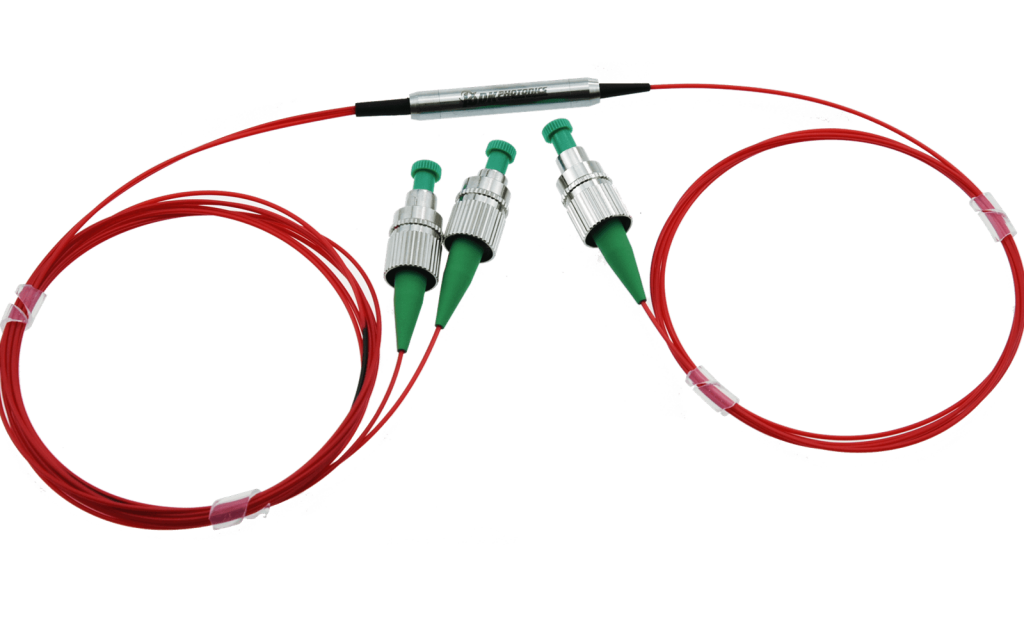
The 1550nm Polarization Beam Combiner/Splitter can be used either as a polarization beam combiner to combine light beams from two PM input fibers into a single output fiber, or as a polarization beam splitter to split light from an input fiber into two output fibers of orthogonal polarization states. The most common application is to combine the light of two pump lasers into one single fiber to double the pump power in EDFA or Raman Amplifier.
|
PARAMETER
|
UNIT
|
VALUE
|
||
|
Grade
|
–
|
P
|
A
|
|
|
Operating wavelength
|
nm
|
1550
|
||
|
Operating bandwidth
|
nm
|
±40
|
||
|
Typical insertion loss
|
dB
|
0.40
|
0.50
|
|
|
Max. insertion loss
|
dB
|
0.60
|
0.70
|
|
|
Min. Extinction Ratio(for PBS only)
|
dB
|
22
|
20
|
|
|
Return loss
|
dB
|
>50
|
||
|
Directivity
|
dB
|
>50
|
||
|
Max. Power Handling
|
W
|
0.5, 1, 2, 3, 5, 10, 20
|
||
|
Tensile Load
|
N
|
< 5
|
||
|
Fiber Type
|
Port 1&Port2
|
–
|
PM1550-XP
|
|
|
Port 3
|
–
|
SMF-28e or PM1550-XP Fiber
|
||
|
Operating temperature
|
℃
|
-5 ~ +70
|
||
|
Storing temperature
|
℃
|
-40 ~ +85
|
||
|
Package dimension
|
mm
|
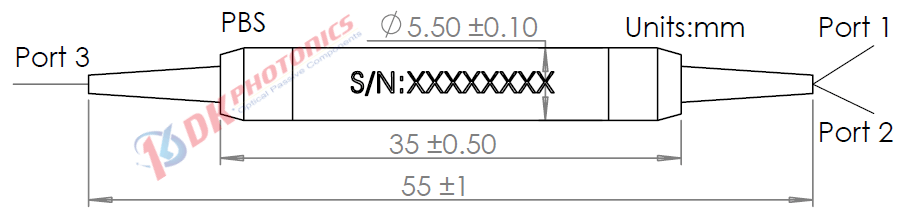
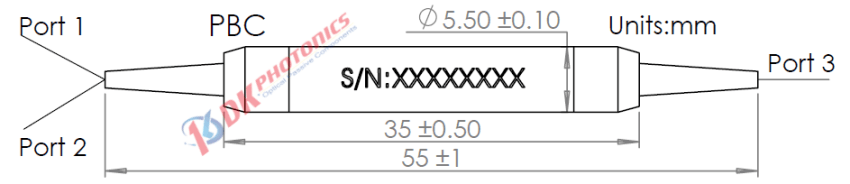
Ø5.5 x 35 or customer specified
|
||
A 1550nm polarization beam combiner/splitter is a fiber optic component that can operate as either a polarization beam combiner or a polarization beam splitter. It combines light from two polarization-maintaining (PM) input fibers into a single output fiber or splits light from one input fiber into two orthogonal polarization output fibers.
A polarization beam splitter (PBS) separates light entering a single input fiber into two output fibers with orthogonal polarization states. Because the device is bidirectionally reversible, it can also function as a polarization beam combiner depending on the direction of light transmission.
A polarization beam combiner combines light from two PM input fibers into a single output fiber, while a polarization beam splitter separates light from one input fiber into two orthogonally polarized output fibers. The same device can perform both functions because it operates bidirectionally.
A fiber polarization beam splitter and polarization beam combiner are commonly used to combine the output of two pump lasers into a single fiber to increase pump power in EDFA and Raman amplifier applications.
The device has a center operating wavelength of 1550 nm with an operating bandwidth of ±40 nm, making it suitable for optical systems operating around the 1550 nm wavelength.
The polarization beam splitter offers a typical insertion loss of 0.40 dB (P Grade) and 0.50 dB (A Grade), with maximum insertion loss of 0.60 dB and 0.70 dB, respectively. For PBS operation, the minimum extinction ratio is 22 dB (P Grade) and 20 dB (A Grade).
Ports 1 and 2 use PM1550-XP polarization-maintaining fiber, while Port 3 supports either SMF-28e fiber or PM1550-XP fiber, depending on the application requirements.
The fiber optic beam combiner is available with maximum power handling options of 0.5 W, 1 W, 2 W, 3 W, 5 W, 10 W, and 20 W. For applications above 5 W, DK Photonics provides a heat sink package for improved thermal management.
Yes. DK Photonics offers custom polarization beam combiner/splitter solutions, including custom fiber pigtails, different operating wavelengths, higher power handling, and other customer-specific requirements.
For devices supplied with connectors, the insertion loss increases by 0.3 dB, the return loss decreases by 5 dB, and the extinction ratio decreases by 2 dB. The default connector key is aligned to the slow axis, and connectorized devices are recommended for power transmission below 2 W.
| ① | ② | ③ | ④ | ⑤ | ⑥ | ⑦ |
| Grade | Operating Wavelength | Power Handling(Total) | Fiber type (Port3) | Pigtails Diameter | Fiber Length | Connector |
|
P:P
A:A
|
15:1550nm
XX: Others
|
L:<0.5W
1:1W
2:2W
5:5W
10:10W
|
1:SM fiber
2:PM fiber, slow axis 45° to port 1
3:PM fiber, slow axis aligned to port 1
|
25:250μm
90:900μm
XX: Others
|
08:0.8m
10:1.0m
XX:Others
|
00:None
FP: FC/PC
FA: FC/APC
LA: LC/APC
XX: Others
|
Description: 1550nm Polarization Beam Splitter, 0.5W power, P grade, PM fiber at port 3, and slow axis aligned to port 1, with 0.9mm OD loose tube, 1.0m fiber length, and FC/APC connectors at all ports.
If you need to customize other specifications, please provide detailed description for your requirement.
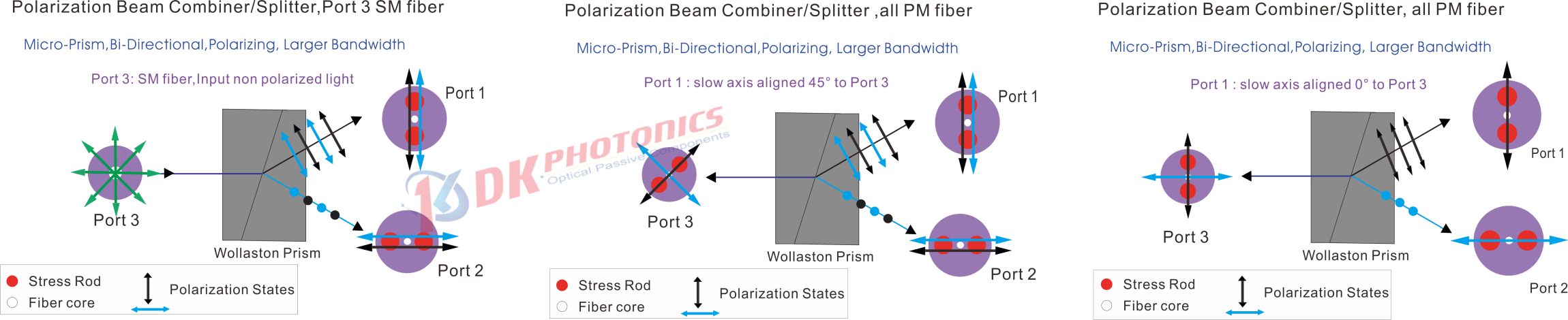
| Polarization Beam Combiner:
Routing path is from port 1, 2 to 3, Here are three options of polarized state from Port 1, 2 to Port 3 |
|
| Option 1:PM to SM fiber | Port 1: 50%, Linear polarized light in, through slow axis,
Port 2: 50%, Linear polarized light in, through slow axis Port 3, 100%, Circularly polarized light Out, |
| Option 2: PM to PM fiber, port 1 is slow axis 0° aligned to port 3 | Port 1, 2, only work through slow axis, blocked the fast,
The slow axis of port 1 is aligned to the slow axis of port 3, The slow axis of port 2 is aligned to the fast axis of port 3, |
| Option 3:PM to PM, port 1 is slow axis 45° aligned to port 3 | Port 1, 2, only work through slow axis, blocked the fast,
Port 1 or 2, 100%, Linear polarized light in, through slow axis, Port 3, 25% linear polarized light out, through slow axis, and 25% by the fast, |
| Polarization Beam Splitter:
Routing path is from port 3 to 1,2, Here are three options of polarized state from Port 3 to Port 1 & 2 |
|
| Option 1: SM to PM fiber | Port 3, Circularly polarized light in,
Port 1: 50%, Linear polarized light out, through slow axis, Port 2: 50%, Linear polarized light out, through slow axis |
| Option 2: PM to PM, port 3 is slow axis 0° aligned to port 1 | 1. Port 3, Linearly polarized light in, through slow axis,
Port 1: 100%, Linear polarized light out, through slow axis, Port 2: 0% 2. Port 3, Linearly polarized light in, through fast axis, Port 1: 0%, Port 2: 100%, Linear polarized light out, through slow axis |
| Option 3: PM to PM, port 3 is slow axis 45° aligned to port 1 | 1. Port 3, Linearly polarized light in, through slow axis,
Port 1: 50%, Linear polarized light out, through slow axis, Port 2: 50%, Linear polarized light out, through slow axis 2. Port 3, Linearly polarized light in, through fast axis, Port 1: 50%, Linear polarized light out, through slow axis, Port 2: 50%, Linear polarized light out, through slow axis |
 DownloadDatasheet in PDF